
AI News November 2025: GPT-5.1, Gemini 3.0, and the Rise of Agentic AI
The AI news of November 2025 redefined the rules of the game: OpenAI prepares GPT-5.1 with deep reasoning, Google unveils Gemini 3.0 Computer Use, and Microsoft/NVIDIA launch the Agentic Launchpad. Here is the complete analysis.

Updated

AI News November 2025: GPT-5.1, Gemini 3.0, and the Rise of Agentic AI
November 2025 was a turning point. Not an isolated announcement, not just another product launch — but a convergent set of signals that sketch a new era of artificial intelligence.
The AI news of November 2025 redefined the rules on several fronts simultaneously. OpenAI prepares GPT-5.1 with deep reasoning capabilities. Google reveals that Gemini 3.0 will be able to control your computer on your behalf. Microsoft and NVIDIA team up to accelerate the next generation of autonomous agents. And meanwhile, NVIDIA crosses a stock market valuation threshold that takes your breath away, while Europe continues to navigate the uncertainty of AI regulation.
This month crystallized a transition that had been building for months: AI is no longer content to answer questions or generate content. It is starting to act. And this difference — seemingly subtle — is in reality the most important technological break of the decade.
In this article, we break down each major announcement of November 2025, their technical workings, their practical implications, and what they collectively mean for entrepreneurs, developers, and decision-makers who want to understand where AI is taking us.
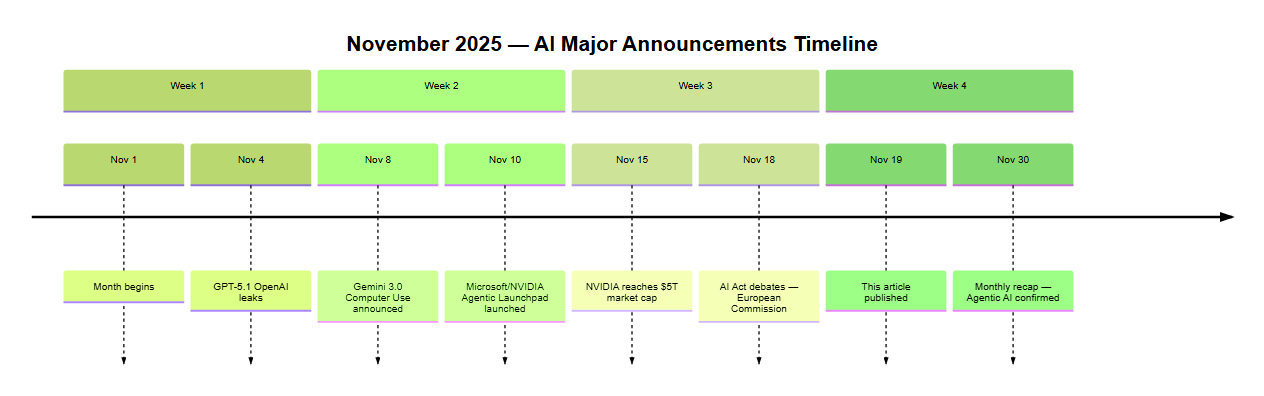 November 2025: GPT-5.1, Gemini 3.0 Computer Use, Microsoft/NVIDIA Agentic Launchpad, NVIDIA $5T valuation
1. The Model War: OpenAI vs Google
Since 2023, the competition between OpenAI and Google has turned into a genuine technological arm-wrestling match. Every announcement from one provokes a reaction from the other. November 2025 was no exception, with two revelations that illustrate both the convergence and divergence of their visions.
OpenAI and the GPT-5.1 Rumors: Reasoning as the Decisive Advantage
While GPT-5 was still awaited, leaks and partial announcements began circulating in early November 2025 around a major intermediate version called GPT-5.1. These pieces of information — coming from sources close to OpenAI according to information available at the time — indicated that this version was not simply an incremental update, but a paradigm shift in how large language models process complex problems.
The first expected improvement concerns deep reasoning, often referred to as "System 2 Thinking." This concept draws directly from the work of psychologist Daniel Kahneman, who distinguishes two thinking modes: System 1, fast and intuitive, and System 2, slow, deliberate, and analytical. Current LLMs operate primarily in System 1 mode — they generate responses by predicting the next most probable token, without necessarily verifying the logical consistency of their reasoning. The result: hallucinations, errors on complex calculations, inconsistencies in multistep tasks.
GPT-5.1, according to information available at the time, would integrate a mechanism allowing the model to "pause" before answering: decompose the problem into sub-steps, verify each step, then synthesize a final answer. This process costs more compute time, but it drastically reduces errors on tasks like advanced mathematical problem-solving, complex code analysis, or legal and medical reasoning. For businesses that use AI on critical processes, this is a fundamental difference between a playful tool and a reliable operational one.
The second improvement concerned extreme personalization. Current models have a contextual memory limited to their context window — typically a few tens to hundreds of thousands of tokens. With each new conversation, the model starts from scratch. GPT-5.1 would integrate a considerably more sophisticated long-term memory, capable of retaining the preferences, style, ongoing projects, and work patterns of a user over the long term. The goal would be that an entrepreneur who has been working with the tool for several weeks gets responses calibrated to their sector, technical level, and habits — without having to re-explain everything at each session.
For professionals who use AI daily, these two combined improvements represent a substantial qualitative leap. It is no longer a tool you query: it is a collaborator who knows your context and thinks alongside you.
Google Gemini 3.0 and "Computer Use": AI Takes the Wheel
For its part, Google was already deploying Gemini 2.5 throughout autumn 2025. But the tech community's eyes were turning toward Gemini 3.0 and its flagship feature: "Computer Use."
Concretely, what is Computer Use? It is the ability of an AI model to observe a computer screen, understand what it sees (buttons, menus, input fields, data), and interact with the graphical interface exactly as a human user would: moving the mouse, clicking, typing text, opening applications, copy-pasting data between different software. The model doesn't need access to a software's API — it "sees" the interface and uses it.
According to information available at the time, Google was inspired by Anthropic's work, whose Claude model had already demonstrated similar capabilities in an earlier version. The practical scope is immense. Imagine an agent capable of: retrieving data from a website that has no API, copying it into an Excel spreadsheet, generating a report in Google Docs, then sending everything by email — all entirely autonomously, without human intervention.
The implications for SMEs are particularly significant. Many business processes still rely on older software that lacks modern integrations. Computer Use would allow "plugging" AI intelligence into these legacy systems without having to replace them. It is also a threat to certain professions related to data entry or repetitive office tasks.
It is worth noting that the announcements around Gemini 3.0 in November 2025 were still partial — the full rollout of these features continued in the following months. But the direction was clear, and the competition with OpenAI was now being played on the field of action, not just generation.
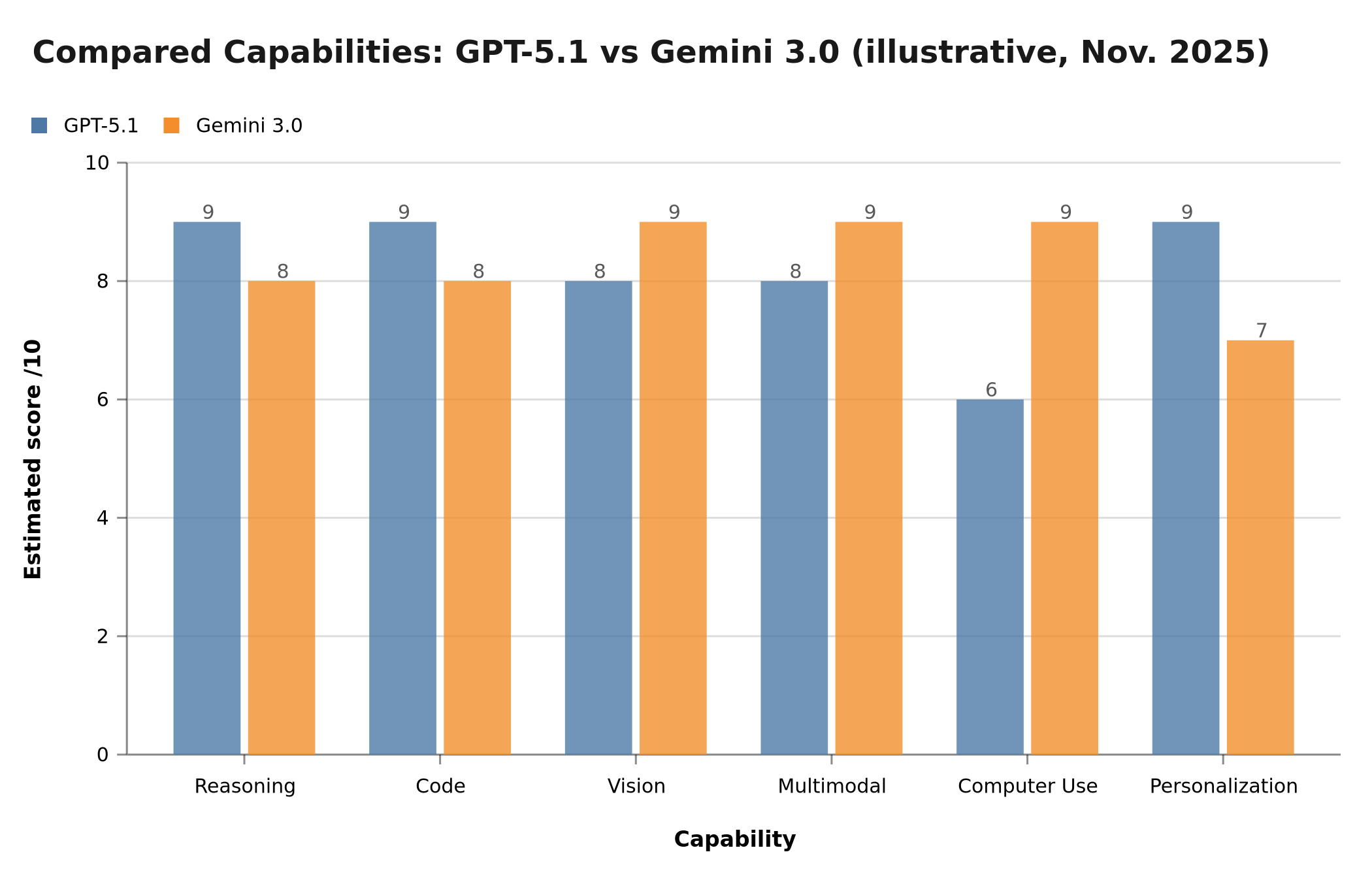 Illustrative comparison of GPT-5.1 and Gemini 3.0 capabilities based on information available in November 2025
2. The Shift to Agentic AI
The term "agentic AI" is everywhere since late 2025. It is tempting to treat it as yet another buzzword. That would be a mistake. Behind this term lies a fundamental architectural change in how AI systems are designed and used.
From Generation to Action: Understanding the Break
To fully grasp what agentic AI is, one must first understand what traditional generative AI is not. A traditional LLM works on a question-answer principle: the user formulates a query, the model generates a textual response. Execution remains the human's responsibility. If you ask ChatGPT "How do I send a bulk email with Python?", it gives you the code — but you run it, manage the errors, retry if needed.
Agentic AI fundamentally changes this paradigm. An AI agent does not answer the question "How to do X?" — it executes X. It has tools (web browser, terminal, API access, file manager), memory, and the ability to plan. It breaks down a complex goal into sub-tasks, executes each step using available tools, evaluates whether the result is satisfactory, and tries again if necessary. It is an action-observation-correction loop that does not need human intervention at each step.
Concretely, if you tell an AI agent "Generate and send a weekly sales report to our team," the agent will: access your CRM to extract data, calculate key metrics, generate a presentation or PDF, identify recipients in your email tool, draft a personalized cover message, and send it all — without you having to intervene. This type of workflow was already possible with no-code tools like n8n or Make, but integrating a deep intelligence layer transforms these automations into something far more adaptable. To learn more about these intelligent automations, read our article on how to transform your workflows into intelligent systems with n8n.
The Agentic Launchpad: Microsoft and NVIDIA Bet Their Future on Agents
The real infrastructure news of November 2025 was the joint launch of the Agentic Launchpad by Microsoft and NVIDIA. This program is not merely an investment fund or a hackathon: it is a complete ecosystem designed to accelerate startups building autonomous AI agents.
Concretely, the Agentic Launchpad offered, according to information available at the time: preferential access to Microsoft Azure cloud resources (GPUs, models, data pipelines), credits to use NVIDIA's Blackwell chips — the most powerful on the market at that point —, technical coaching from specialized engineers, and access to a network of commercial partners to accelerate go-to-market.
But beyond the program itself, this launch sends a clear signal: Microsoft and NVIDIA see agentic AI as the next mega-market. Both companies had already captured most of the value created by the first cycle of generative AI (Microsoft through its integration of GPT into Office Suite and Azure, NVIDIA through GPU sales). By positioning themselves so early on agentic AI, they sought to renew that competitive advantage for the next cycle.
For technical startups and entrepreneurs, this signal deserves serious attention. The market for agentic tooling — agent orchestration, monitoring, security, memory management, tool use — was still largely open in November 2025. The window to position on this segment was identified as particularly favorable.
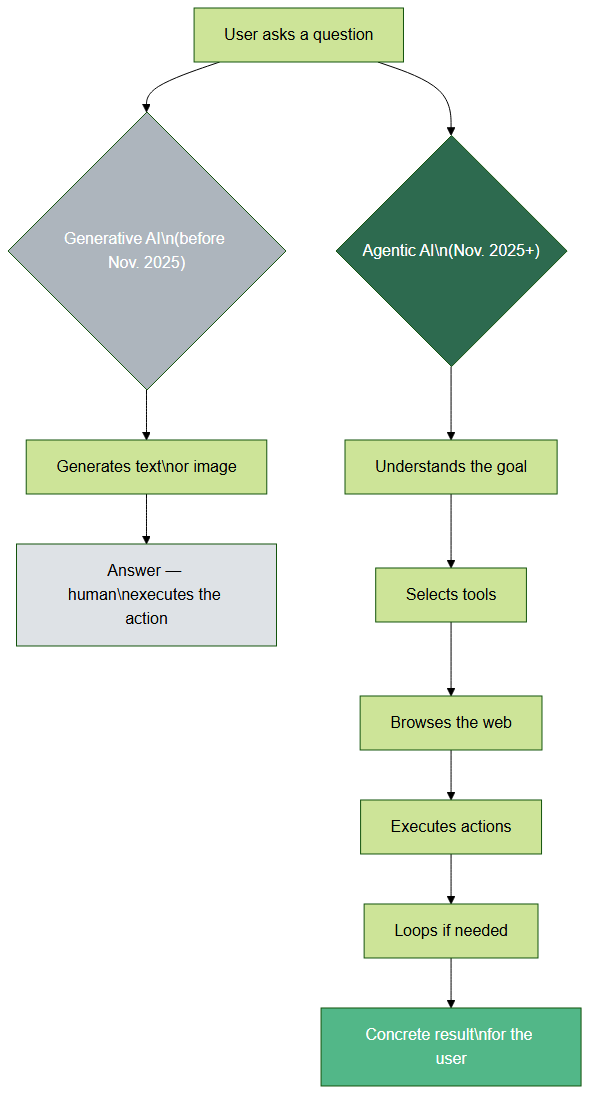 Agentic AI executes actions in a loop, whereas generative AI only produces text or images
3. Hardware: NVIDIA, the Kingmaker of the AI Era
To understand why NVIDIA's valuation at 5 trillion dollars generated so much buzz in November 2025, one needs to revisit the fundamentals of the AI economy.
Training a large language model requires thousands of GPUs working in parallel for weeks or months. Inference — running the model to respond to user queries — also requires GPUs, continuously and at very large scale. In this ecosystem, NVIDIA's GPUs are not just one component among many: they are the strategic bottleneck of the entire AI industry.
The Blackwell chips, launched in 2024 and deployed massively in 2025, represented at the time the pinnacle of performance for AI training and inference. Their superiority over the previous generation (Hopper) was substantial, with significant performance and energy efficiency gains according to the NVIDIA technical documentation available at the time. Demand for these chips was such that delivery lead times stretched over several quarters, and major players like Microsoft, Google, Meta, and Amazon were literally competing to secure their allocations.
In this context, the $5 trillion valuation was not — according to analysts at the time — a sign of speculative bubbling. It reflected structural demand: every new AI model launched by OpenAI, Google, or an independent actor required tens of thousands of NVIDIA GPUs. Every new AI startup that raised funds spent a large portion on compute. And every cloud provider data center expansion added thousands of Blackwell chips to NVIDIA's revenue.
The question of energy consumption was simultaneously becoming a geopolitical issue. A large model training data center consumes as much electricity as a medium-sized city. US states began negotiating access to additional energy sources (nuclear, renewables) to power this infrastructure. In Europe, the energy constraint was identified as an additional brake on developing a competitive continental AI industry.
NVIDIA's story in November 2025 illustrates a general principle: in any gold rush, pickaxe suppliers get rich. OpenAI needs NVIDIA to train GPT. Google needs NVIDIA for Gemini. Startups building agents need NVIDIA to run their models. NVIDIA, for its part, needs AI to keep progressing so demand remains sustained. It is a relationship of mutual dependency, and the balance was very favorable to the hardware supplier in November 2025.
4. Regulation: Europe Faces the AI Act Dilemma
While the United States accelerates and China invests massively, Europe is questioning itself. The November 2025 debates around the AI Act reveal a fundamental tension structuring European technology policy: how to protect without paralyzing?
The European AI Act, adopted in its broad outlines in 2024, provides a differentiated regulatory framework based on the risk level of AI systems. Limited-risk systems (chatbots, image generators) are subject to light transparency obligations. High-risk systems (hiring decisions, credit, justice, health) are subject to strict requirements for documentation, auditability, and human oversight. And certain systems are simply prohibited (mass biometric surveillance, behavioral manipulation).
In November 2025, according to information available at the time, the European Commission was showing signs of hesitation on the enforcement timeline for these rules. The main concern was "competitive decoupling": if European companies are subject to costly requirements that their American competitors do not have, they accumulate a structural disadvantage at the precise moment when dominance of next-generation models is being decided.
This debate pits two legitimate visions against each other. On one side, proponents of strong regulation point out that high-risk AI systems make decisions affecting millions of people — credit, hiring, healthcare decisions — and that human oversight is not optional, it is a matter of fundamental rights. On the other side, European industrialists and researchers argue that regulatory innovation must be proportionate to real risks, and that an adaptation period is necessary for companies to comply without compromising their competitiveness.
The tension was real and unresolved in November 2025. What it reveals is that Europe is playing on difficult terrain: it has no NVIDIA, no OpenAI, no Google. It does, however, have world-class researchers, a domestic market of 450 million consumers, and a solid legal tradition in data protection. The challenge was to transform these assets into a competitive advantage rather than a brake.
5. Cross-Sectional Analysis: What November 2025 Means for Agentic AI
Taken individually, each of these events is remarkable. Taken together, they tell a much bigger story: the shift of AI toward a new era of operation.
The Convergence Toward Autonomous Action
GPT-5.1 with its deep reasoning, Gemini 3.0 with its Computer Use, the Microsoft and NVIDIA Agentic Launchpad: these three announcements all point in the same direction. The next-generation AI is no longer a passive tool you query — it is an actor you commission.
This semantic shift has enormous practical consequences. A passive tool is used. An actor is supervised. The relationship between humans and AI changes in nature: we move from the paradigm "humans do, AI helps" to the paradigm "AI does, humans validate." For businesses, this means profoundly revisiting not only processes, but also responsibilities, controls, and verification mechanisms.
The question of reliability becomes central. A writing assistance tool that hallucinates is annoying — you reread and correct. An agent that hallucinates while executing actions (sending an email to the wrong person, deleting a file, placing an incorrect order) can cause real and difficult-to-reverse damage. This is why work on reducing hallucinations and ensuring the reliability of agentic systems had become an absolute priority. Our article on how to avoid AI hallucinations in your company delves deeper into this crucial topic.
Infrastructure as a Geopolitical Issue
NVIDIA's valuation and the tensions around the AI Act together reveal a reality that strategic thinkers were beginning to fully integrate in November 2025: AI is critical infrastructure, on par with electrical grids or roads. The country (or economic bloc) that controls this infrastructure exerts disproportionate influence on the global digital economy.
In this framework, decisions made in 2025 and 2026 around regulation, R&D investment, and access to compute resources will have consequences for decades. Europe's hesitation on the AI Act is not just a legal question — it is a matter of strategic positioning in the geopolitics of AI.
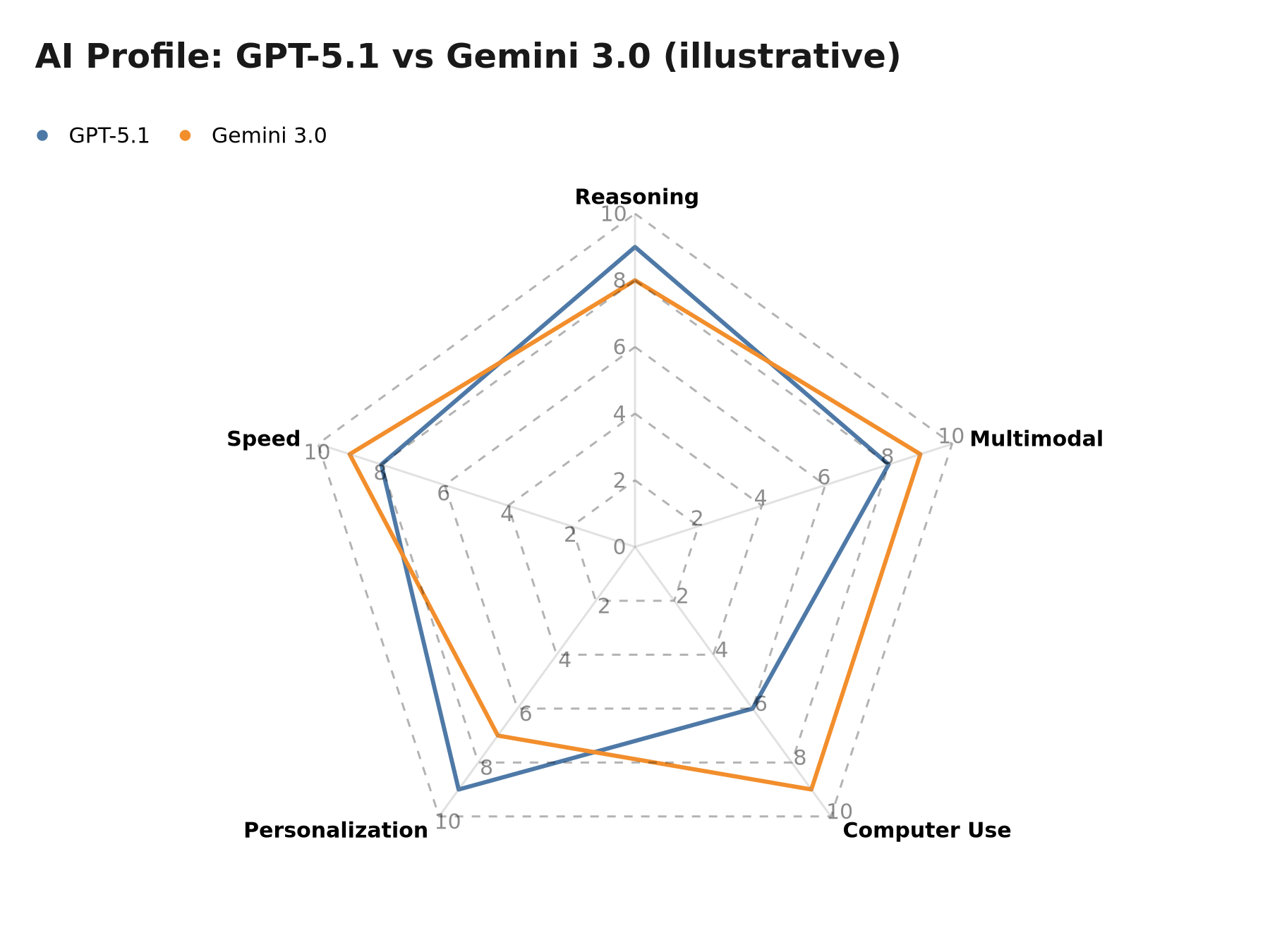 Illustrative radar comparison of GPT-5.1 and Gemini 3.0 capabilities based on November 2025 announcements
6. Emerging Trends: What November 2025 Foreshadows for 2026
The signals from November 2025 allowed, in hindsight, the identification of several trends that would structure 2026.
The Explosion of Specialized Agents
Competition would no longer play out solely between large generalist models. The real battlefield would shift toward vertical agents — AI agents specialized in a specific domain: accounting, recruitment, project management, customer support, financial analysis. These agents combine the power of a base LLM with domain-specific tools, sector databases, and workflows optimized for a particular use case.
For developers and tech entrepreneurs, this represents a considerable opportunity. The barriers to entry for building a vertical agent are significantly lower than for training a foundation model. And the value created can be very high if the agent solves a real problem with sufficient reliability.
The Question of Trust and Transparency
As AI agents make decisions and execute autonomous actions, the question of transparency becomes unavoidable. In November 2025, the first serious discussions around explainable AI applied to agents were emerging: how can an agent justify its decisions? How can a human operator audit what an agent has done, and why?
This challenge was not yet resolved, but it directly conditioned the adoption of AI agents in regulated sectors like finance, healthcare, or law. Companies that would build auditability and traceability solutions for AI agents were well-positioned to capture significant value.
Energy Consumption as a Systemic Constraint
The AI of 2025 consumes enormous amounts of energy — both for model training and for large-scale inference. With the proliferation of agents running continuously (instead of responding to punctual queries), energy consumption was set to mechanically increase. More efficient models (compression, distillation, quantization) and energy-efficient hardware architectures were set to become primary concerns.
For companies deploying AI at scale, the energy cost — and therefore the compute cost — was going to become a central element of ROI calculations.
7. What Entrepreneurs Should Take Away from November 2025
November 2025 was not a technological curiosity reserved for research engineers. It was a month of strategic decisions for every business leader or tech decision-maker.
First lesson: the time to familiarize yourself with agentic AI is now. Agentic AI was still an emerging technology in November 2025, but the adoption pace was set to accelerate considerably in 2026. Entrepreneurs who understood the fundamentals — what an agent is, how it orchestrates tools, which use cases it solves better than classical automation — had a head start in riding the next wave.
Second lesson: watch the tooling market, not just the models. GPT-5.1 and Gemini 3.0 captured the attention, but the most immediate commercial opportunity lay in the tooling around agents: monitoring, security, memory management, orchestration, supervision interfaces. This market was still largely open in November 2025. To contextualize these dynamics in the global competition between closed and open AI actors, our analysis on the open vs closed AI war in 2026 is particularly illuminating.
Third lesson: European regulation creates both risks and opportunities. For European companies, the regulatory uncertainty of November 2025 was a risk to manage — but also an opportunity. Companies that would proactively comply with the AI Act requirements (transparency, auditability, human control) would have a real competitive advantage on European markets and in public procurement tenders.
Fourth lesson: reliability trumps raw performance. For professional applications, an agent that correctly completes 85% of tasks while sometimes producing incorrect results is not usable. An agent that correctly completes 95% of tasks with reliable detection and escalation mechanisms is. Investment in quality and reliability was going to become the primary differentiator. To understand how AI is scaling across enterprises, also read our analysis on OpenAI's historic $110 billion fundraise.
Conclusion — November 2025: The Month AI Started to Truly Act
November 2025 confirms that AI is not a passing fad. It is a groundswell redefining computing at a fundamental level. The convergence of GPT-5.1 (deep reasoning), Gemini 3.0 (Computer Use), the Agentic Launchpad (agent ecosystem), NVIDIA at $5 trillion (infrastructure), and the tensions around the AI Act (regulation) paints a coherent picture: we are entering the era of AI that acts.
The human-machine interface is changing. We will soon no longer click on buttons to accomplish repetitive tasks — we will define objectives, and agents will execute them. This is not science fiction: the technological building blocks were all there in November 2025. What remains to be built is the trust, reliability, and safeguards that will allow these systems to operate responsibly in the real world.
For entrepreneurs and decision-makers, the message is clear: this is no longer the time to watch from a distance. It is the time to understand, experiment, and position yourself.
Stay connected on BOVO Digital to follow how these technologies can be concretely applied to your business.
Tags
FAQ
What is the 'Computer Use' feature announced with Gemini 3.0 in November 2025?
Computer Use is a capability that allows an AI model to take control of a computer's graphical user interface to perform concrete tasks: clicking, typing, navigating through applications, filling out forms. Based on information available at the time, Google developed this capability inspired by Anthropic's earlier work, positioning Gemini 3.0 as a true assistant capable of acting, not just responding.
What is the System 2 Thinking reasoning attributed to GPT-5.1?
System 2 Thinking refers to the cognitive model by psychologist Daniel Kahneman. "System 2" is the slow, deliberate, and analytical thinking, as opposed to "System 1" which is fast and intuitive. Applied to AI, this means the model takes time to decompose a problem into steps before responding, thereby drastically reducing errors and hallucinations on complex tasks. The November 2025 leaks indicated that OpenAI was integrating this mechanism into GPT-5.1 to improve reliability on multistep reasoning tasks.
What is the Agentic Launchpad launched by Microsoft and NVIDIA?
The Agentic Launchpad is a joint program by Microsoft and NVIDIA announced in November 2025, designed to accelerate startups developing autonomous AI agents. It is an ecosystem combining access to cloud infrastructure (Azure), NVIDIA GPUs (Blackwell chips), agent development tools, and a network of mentors and investors. The stated goal was to make agentic AI the next major technological paradigm after generative AI.
Why was the European Commission hesitating to strictly enforce the AI Act in November 2025?
Based on information available at the time, the European Commission feared that overly strict enforcement of the AI Act rules would stifle innovation in European companies facing American and Chinese competition. The debate pitted supporters of a robust regulatory framework to protect citizens' rights against industry leaders and researchers who advocated for a grace period to avoid penalizing European actors at a crucial moment in AI development.
How does the agentic AI of November 2025 concretely change entrepreneurs' work?
Agentic AI transforms the relationship with work by enabling automated systems to execute complete chains of tasks autonomously: searching for information, drafting and sending emails, updating databases, generating reports. Concretely, an entrepreneur can configure an agent to manage prospecting, customer service, or competitive intelligence, without human intervention at each step. Tools like n8n or Make already allow building these agentic workflows.
Is NVIDIA's $5 trillion valuation sustainable?
According to analyses available at the time, NVIDIA's record valuation reflected real and structural demand for GPU chips for AI data centers. Orders for Blackwell chips were far ahead of production capacity. This does not guarantee the valuation will remain at that level, but it indicated that AI infrastructure demand was anchored in real needs rather than speculation, at least in the short term.
Free audit: we check the impact on your site and workflows
Next.js CVE, new agent, MCP… We tell you what actually applies, and what to patch or ignore.
- 30 min
- Stack reviewed
- No commitment
Déo-Gratias LOKONON
E-Commerce & SEO Expert. Shopify, PrestaShop and digital acquisition strategist. Graduated from Polytech Nantes.


