
Tech Recap February 2026: Claude Opus 4.6, Gemini 3.1, and the Race to 110 Billion
February 2026 was the most intense month in AI history. Claude Opus 4.6, Gemini 3.1 Pro, OpenAI's record fundraise, and the Anthropic-Pentagon affair. Full recap and analysis.

Updated

Tech Recap February 2026: Claude Opus 4.6, Gemini 3.1, and the Race to $110 Billion
February 2026 compressed into twenty-eight days what the AI industry used to spread over an entire year. To make sense of these AI news from February 2026, here is our complete analysis of this historic month.
February 2026 stands as the most eventful month in recent tech history. Within a few weeks, two AI giants launched next-generation models, OpenAI closed the largest fundraising round ever recorded for a private company, NVIDIA posted record financial results, and a major ethical crisis redefined the relationship between artificial intelligence and US national security. This is not an ordinary month. It is a pivotal moment — the kind that divides an industry's history into a before and an after.
This recap is not simply a list of events. It is an attempt to analyze what these facts mean concretely: for developers building products, for entrepreneurs looking to integrate AI into their operations, and for decision-makers trying to understand the technological landscape they are navigating. All analyses presented here draw from information available at the time of the events and are presented as our reading of these situations, not as established facts.
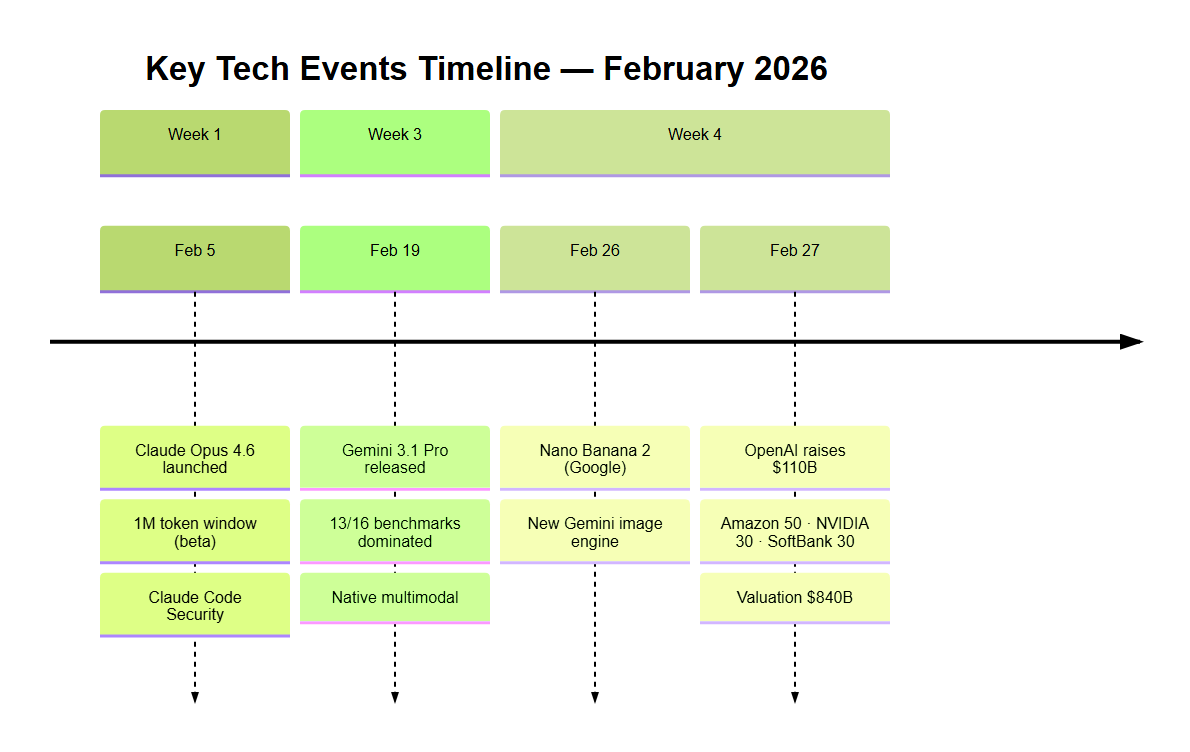 Complete timeline of key events in February 2026
Context: Why February 2026 Is a Pivotal Month
To understand the intensity of what happened in February, the events must be placed in context. Since 2023, the AI industry has been evolving at a pace that defies conventional wisdom. Every quarter brings its share of more powerful models, record funding, and bold statements. But February 2026 is different in several ways.
First, the temporal concentration: four distinct major events occurred within twenty-two days. These are not minor announcements or marginal iterations. Each one would have, on its own, dominated specialized coverage for an entire month. Together, they draw a new geography of the industry.
Second, the financial dimension is without precedent. OpenAI's $110 billion raise does not simply continue the trend of previous funding rounds. It signals an institutionalization of AI as critical infrastructure — in the same way that cloud or telecommunications had been in previous decades. When Amazon, NVIDIA, and SoftBank unite to fund a single company with $110 billion, this is no longer venture capital: it is infrastructure construction.
Finally, the ethical and geopolitical dimension has entered the equation in an irreversible way. Anthropic's exclusion from US federal agencies raises a question that extends well beyond this particular case: how far can an AI provider resist demands from a sovereign state without losing access to its most lucrative markets? Anthropic's answer — maintaining its ethical safeguards even at the cost of exclusion — and OpenAI's answer — signing a deal with the Pentagon — have created a public divide that will structure industry debates for a long time to come.
New Models: Claude and Gemini in Direct Confrontation
Claude Opus 4.6: The AI That Bets on Depth (February 5)
On February 5, Anthropic launched Claude Opus 4.6, and the announcement immediately captured the developer community's attention. The first notable element is the one-million-token context window, available in beta. To put this number in perspective: one million tokens represents approximately 750,000 words — the equivalent of five to six standard-length novels. In practice, this means a developer can submit to Claude an entire medium-sized codebase, or a corporate document corpus of several hundred pages, and receive a response that accounts for the complete context — without needing to split, summarize, or pre-select the relevant information.
This capability is far from trivial. One of the fundamental challenges of LLMs in professional applications has always been context window limitations: the model "forgets" the beginning of a long conversation, or cannot integrate an entire technical documentation set into its response. With one million tokens, this constraint recedes significantly for the majority of real-world use cases.
The second major contribution concerns reasoning on code tasks. According to information available at the time, Claude Opus 4.6 shows meaningful improvements on complex debugging exercises, code generation in less common languages, and understanding of sophisticated architectural structures. This is not simply about writing syntactically correct code — which most modern models already do well — but about understanding architectural patterns, identifying performance or security issues in complex systems.
The 30% reduction in response time compared to the previous version is also significant. In applications with high user interaction — assistants, conversational interfaces, productivity tools — latency is not a technical detail. It directly conditions the perceived experience. A 30% reduction can make the difference between a fluid interface and a frustrating tool.
Finally, the launch of Claude Code Security deserves particular attention. This module aims to identify vulnerabilities introduced by AI-assisted code generation — a growing problem as developers incorporate more automatically generated code into their projects. According to our reading of this announcement, Anthropic positions Claude Code Security as a direct response to growing concerns about the security of AI-generated code, a critical issue as such code enters production systems.
For developers, the practical question is: does Claude Opus 4.6 justify a workflow change? If you work on projects involving the analysis of large volumes of documents, code, or textual data, the answer is probably yes. If your use cases are simpler and more punctual, the cost-benefit ratio will need to be evaluated case by case.
Gemini 3.1 Pro: Google's Offensive Response (February 19)
Two weeks after the Claude Opus 4.6 launch, Google responded with Gemini 3.1 Pro, and the response was spectacular. The most-cited figure in analyses from the time: 13 of 16 reference benchmarks dominated. This is a remarkable score, even though academic benchmarks do not always reflect real-world performance. According to our reading of these results, they nonetheless signal substantial progress across several key dimensions: mathematical reasoning, logical comprehension, code generation, and multimodal processing.
Doubled logical reasoning compared to the previous version is one of the most significant improvements. Logical reasoning is one of the dimensions that most clearly distinguishes state-of-the-art models from general-purpose models. A model that reasons well is capable of decomposing complex problems into sub-problems, maintaining consistency across long deduction chains, and identifying contradictions in its own reasoning — which significantly reduces hallucinations on analytical tasks.
The native one-million-token context window — as opposed to Claude's beta version — is a detail that matters. "Native" means this capability is stably integrated into the production model, with the performance and reliability guarantees that accompany it. The Claude beta version potentially implies instabilities, undocumented limitations, or behavioral changes between versions.
But it is probably native multimodality that constitutes Gemini 3.1 Pro's most distinctive differentiation: text, image, and video processed in an integrated way within a single model, without separate pipeline or sequential processing. For developers building applications involving multiple modalities — document analysis with images, multimedia content generation, automatic video description — this architecture considerably simplifies development.
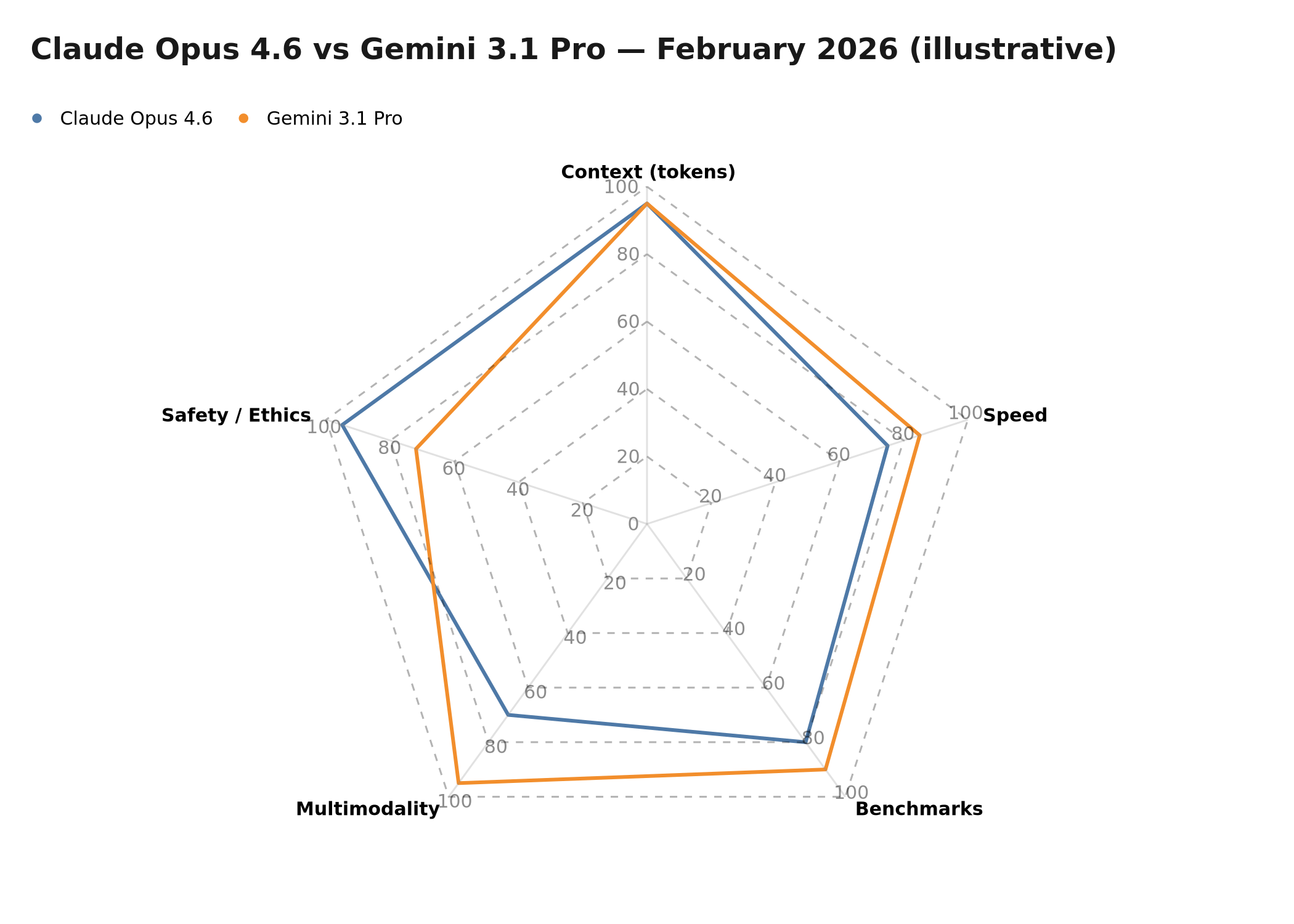 Illustrative comparison of the two models on: context, speed, benchmarks, multimodality and safety — indicative values only
Nano Banana 2: The Battle Shifts to Images (February 26)
On February 26, Google announced Nano Banana 2, its new image generation engine, which becomes the default engine in the Gemini ecosystem. The announced improvements cover generation speed, realism of produced images, and — a particularly notable point — the ability to maintain visual consistency of multiple people within a single image. This last point has historically been one of the weak spots of image generation models, particularly in professional use cases related to advertising or corporate communications.
This launch must be placed in the context of a broader competition for dominance in the image generation segment, where players like Midjourney, Stable Diffusion, and OpenAI's DALL-E have been competing for several years. The fact that Google directly integrates Nano Banana 2 as the default engine in Gemini indicates a vertical integration strategy: rather than offering a separate tool, Google enriches its existing AI ecosystem with new capabilities, thereby strengthening its overall value proposition.
The Fundraise of the Century: OpenAI at an $840 Billion Valuation
On February 27, OpenAI officially closed a $110 billion fundraising round, split between three major investors. Amazon commits $50 billion — making it the lead investor — while NVIDIA and SoftBank each contribute $30 billion. The resulting post-money valuation reaches $840 billion, positioning OpenAI among the most valued companies in the world, well ahead of most public multinationals that have been listed for decades.
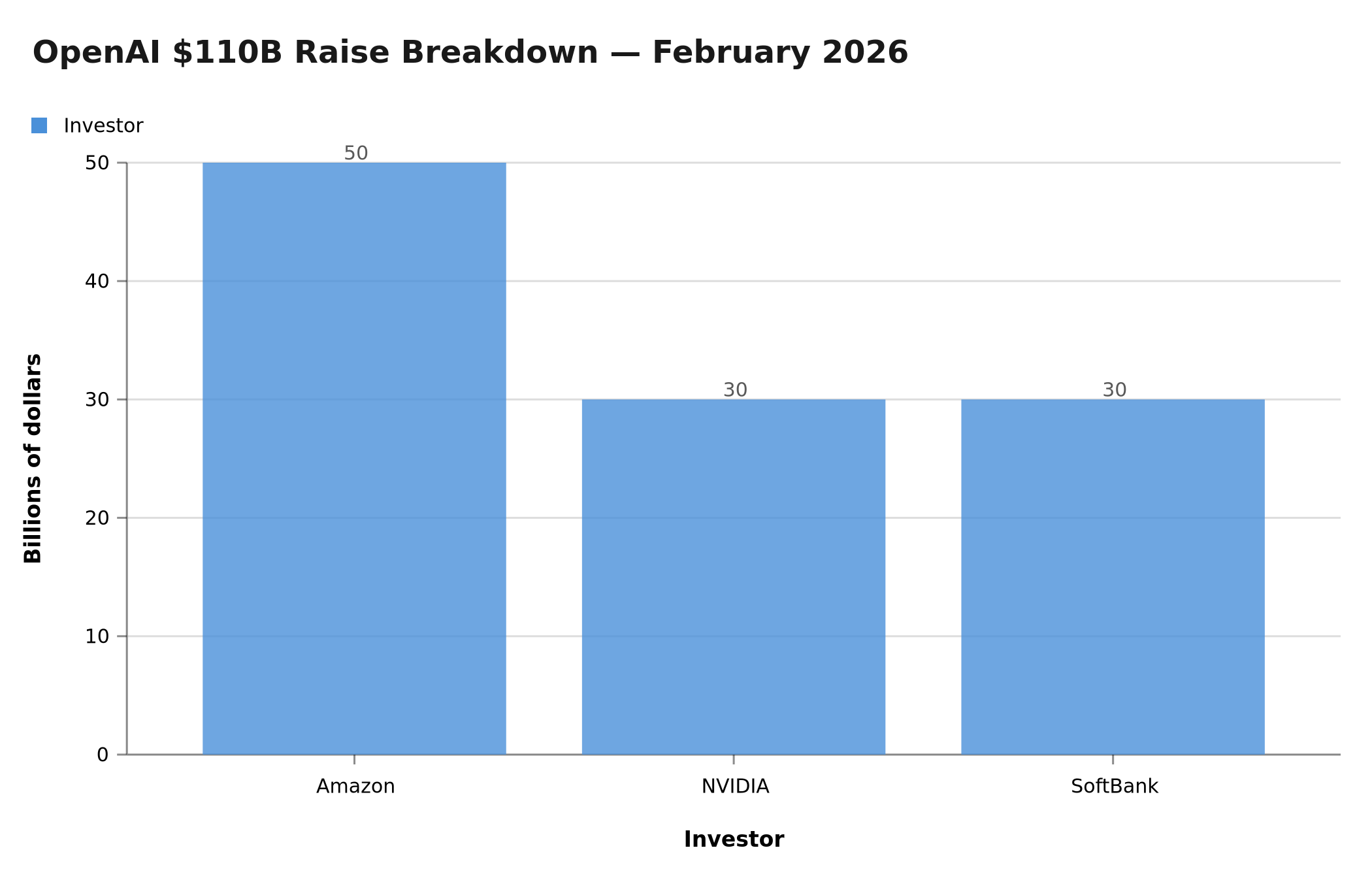 OpenAI investor breakdown for the $110B February 2026 raise
To understand the significance of this raise, the composition of investors must be analyzed as much as the amount. Amazon is OpenAI's reference cloud provider via AWS, and this investment consolidates an already deep commercial relationship. It also signals that Amazon is betting on OpenAI as a long-term strategic partner rather than focusing exclusively on developing its own AI models via AWS. NVIDIA is the indispensable GPU supplier for training and inferring AI models. Its $30 billion investment creates an obvious alignment of interests: the more OpenAI grows, the more NVIDIA sells chips. But this investment also signals that NVIDIA perceives OpenAI as durable infrastructure, not a speculative bubble. Finally, SoftBank, Masayoshi Son's Japanese conglomerate, confirms its massive AI positioning strategy after several years of repositioning post-WeWork.
The usage context is equally revealing: ChatGPT counted at this time 900 million weekly users, according to available information. This figure exceeds the audience of many established social platforms that have been around for more than a decade. It indicates mass adoption built not on technological hype but on utility perceived by hundreds of millions of people in their daily lives.
For a deeper analysis of this raise's implications, consult our detailed piece: OpenAI raises $110 billion — historic turning point for AI.
The questions this raise raises are numerous. First, the question of fund usage: $110 billion allows OpenAI to massively fund data center construction, researcher recruitment, and next-generation model development. According to our reading of the situation, a significant portion of these funds should go toward building compute infrastructure, notably NVIDIA GPU clusters, to reduce OpenAI's dependence on third-party cloud providers. Then, the competition question: with an $840 billion valuation, OpenAI enters a category where few actors can finance or acquire it. This makes it structurally independent of a potential acquisition while strengthening its ability to attract talent through competitive compensation packages.
For entrepreneurs and SMEs using OpenAI's APIs, this raise has practical implications: it guarantees service continuity in the medium term and suggests that GPT-5 and its successors will benefit from considerable research and development resources. It also raises the pricing question: with such high infrastructure costs, how will API access prices evolve? If you are considering integrating OpenAI APIs into a commercial product, find out how to estimate the cost of an AI chatbot in 2026.
The Anthropic-Pentagon Crisis: When Ethics Meets National Security
One of the most significant events of February 2026 is not a technology launch but an institutional rupture: Anthropic was excluded from all US federal agencies after refusing to lift its ethical safeguards at the authorities' request. Simultaneously, OpenAI signed a cooperation agreement with the Pentagon.
This double development creates a clear divide within the industry and deserves nuanced analysis. According to our reading of events, Anthropic has built its reputation and business model on the idea that AI safety is not an obstacle to performance, but a prerequisite. The company has developed "Constitutional AI" techniques and invested heavily in alignment research — the discipline that aims to ensure AI systems act consistently with human values even in situations not anticipated during training.
Refusing to lift these safeguards, even in the face of government agencies, is consistent with this philosophy. But the immediate cost is real: exclusion from the US federal market represents lost access to potentially lucrative contracts, in a sector where governments are becoming increasingly significant buyers of AI solutions.
On the other side, OpenAI made a different choice by signing with the Pentagon. This choice responds to an understandable commercial logic — the US government is one of the world's largest institutional buyers — but raises legitimate ethical questions about potential military uses of models like GPT. According to our reading of the situation, this agreement places OpenAI in a delicate position vis-à-vis the AI research community, which closely monitors the militarization of foundation models.
For companies that need to choose an AI provider, this crisis provides an additional differentiation criterion: what is your provider's policy when facing government demands? This question, which seemed abstract a few years ago, becomes a concrete dimension of supplier risk. It is particularly relevant for European companies subject to GDPR and EU AI regulation, which impose strict requirements on data use and processing.
Hardware: NVIDIA and the Domination of AI Silicon
One cannot discuss AI news from February 2026 without mentioning NVIDIA, whose financial results better illustrate the health of the industry than any analysis could. The firm published quarterly revenue of $68.1 billion, representing 73% year-over-year growth. Over the entire fiscal year, revenue reaches $215.9 billion, a 65% increase.
These figures do not describe a growing company: they describe an exploding sector. And NVIDIA is, according to our reading of the situation, in a near-monopoly position in the AI training GPU market, which explains these spectacular margins and growth rates. The H100 chip, then the H200, have become the inescapable infrastructural elements of any large-scale AI project. The alternatives — AMD with its RDNA GPUs, Google's TPU chips, or Amazon's Trainium — exist but have not yet reached the ecosystem parity that would allow developers to easily bypass them.
The announcement of GTC 2026 (scheduled for March 16-19) with the anticipated unveiling of the Rubin architecture is worth watching. If the Hopper architecture (H100) has defined the standard of the past two years, Rubin could represent the next significant architectural leap — with direct implications for the training and inference capacity available to labs and enterprises in the 18 to 24 months that follow.
For entrepreneurs, the practical lesson is clear: inference costs — the price you pay to use an LLM via an API — remain directly correlated with GPU availability and pricing. As long as NVIDIA maintains its dominant position and demand exceeds supply, these costs will remain high. This reality must inform your architecture decisions: how to avoid AI hallucination traps and reduce re-inference costs.
Tools & Standards: MCP Establishes Itself as the USB-C of AI
One of the least spectacular but perhaps most structurally important developments of February 2026 concerns not a model or a funding round, but a protocol: MCP (Model Context Protocol). This technical standard, which defines how AI models can connect to external tools and data sources, is establishing itself as the USB-C equivalent of the AI ecosystem.
n8n 2.0 announced native MCP support, allowing automation workflows to connect directly to LLMs via this standardized protocol. Make (formerly Integromat) integrated "Next-gen AI Agents" with a Reasoning Panel, which allows users to visualize and audit the reasoning of an AI agent in an automated workflow — a critical feature for companies that want to maintain human oversight over their automated processes.
According to our reading of these developments, MCP addresses a real and growing problem: the fragmentation of interfaces between LLMs and real-world tools. Each AI provider had until now its own integration mechanisms — OpenAI's "function calls," Anthropic's "tools," Google's plugins — which forced developers to maintain multiple parallel integrations for the same functionalities. A standardized protocol eliminates this friction.
For companies building AI workflows, this standardization has concrete implications: integrations developed today with one provider will potentially be reusable tomorrow with another, reducing lock-in risk. This is exactly the kind of structural evolution that favors large-scale AI adoption in enterprise operations.
 Who is impacted how: developers, entrepreneurs, data scientists, CTOs — reading implications by profile
Cross-Cutting Analysis: The Underlying Trends of February 2026
Taken in isolation, each event of this month might seem like just another announcement in an industry accustomed to announcements. But put in perspective, they reveal several underlying trends.
Hardware-software-capital convergence. NVIDIA's investment in OpenAI, combined with Amazon's, illustrates a trend toward AI verticalization. Hardware and cloud giants are no longer content to provide infrastructure: they are becoming shareholders in the models running on that infrastructure. This convergence creates complex market dynamics, where model providers and their infrastructure clients now have intertwined interests.
Context window maturity. The fact that two competing models simultaneously offer a one-million-token window — one in beta, the other in native production — indicates that this capability is becoming a standard rather than a differentiating advantage. Within twelve to eighteen months, according to our projection, the context window will likely no longer be a differentiation criterion among state-of-the-art models.
Ethical polarization. The Anthropic-OpenAI divide around Pentagon cooperation likely announces a lasting market segmentation. On one side, providers that maintain strict ethical policies — potentially at the cost of certain markets — and on the other, providers more accommodating to institutional demands. For AI solution buyers, this divide will become a selection criterion as important as technical performance.
Accelerated standardization. The adoption of MCP by multiple major players in a short time span is a positive signal for the ecosystem as a whole. Open standards reduce barriers to entry and foster innovation. They can also accelerate adoption by companies that still hesitate to commit to solutions perceived as proprietary.
What Concretely Changes for Entrepreneurs and Developers
The events of February 2026 are not merely theoretical. They have immediate practical implications for anyone using or considering using AI in their activities.
For developers, Claude Code Security represents a response to a growing concern: the technical debt and vulnerabilities introduced by massive AI code generation. If you have integrated assisted code generation into your workflow, it is worth evaluating how this module can integrate into your code review processes.
For entrepreneurs and SMEs, the maturity of MCP and its adoption by n8n and Make opens concrete prospects for more sophisticated automation. AI agents capable of reasoning and interacting with your existing business tools are becoming more technically accessible. The question is no longer "is this possible?" but "which use case should be prioritized?"
For CTOs and tech buyers, OpenAI's raise and the Anthropic-Pentagon crisis provide two complementary elements for reflection. First, the financial solidity of AI providers has never been as variable — and as important to evaluate — as a company at an $840 billion valuation is structurally different from a startup. Second, your provider's ethical policy becomes a supplier risk criterion to integrate into your evaluation frameworks, particularly if you operate in regulated sectors.
The comparison between DeepSeek and Western models during this period also raises questions about the balance between open and closed models: decoding the open vs. closed AI war in 2026.
Looking Ahead: What March 2026 Signals
February 2026 cannot be analyzed in isolation. It sets the stage for a March 2026 that promises to be equally dense.
NVIDIA's GTC 2026 (March 16-19) will likely be the most anticipated event of the first quarter. The unveiling of the Rubin architecture — if it confirms rumors of performance two to three times superior to Hopper — will have direct repercussions on the roadmaps of all major AI laboratories. A new generation of more powerful GPUs means more ambitious models in the 12 to 18 months that follow.
Results from the first weeks of Claude Opus 4.6 and Gemini 3.1 Pro usage in production contexts will begin to generate real-world feedback. Academic benchmarks tell one story; performance in real applications with imperfect data and edge cases tells another, often different one.
Finally, the dynamics opened by MCP should produce its first visible effects in terms of third-party tool adoption. If other players — notably CRM, ERP, or marketing platform providers — announce MCP compatibility in March, this will confirm that standardization is genuinely underway.
Conclusion: A Month That Redraws the Lines
February 2026 will remain in the AI industry's annals for several reasons. It saw two state-of-the-art models simultaneously reach the one-million-token threshold. It consecrated OpenAI as a global technological infrastructure with an unprecedented fundraise. It crystallized the ethical debate around AI cooperation with national defense. And it laid the groundwork for a standardization that could make AI accessible to a greater number of enterprises.
For entrepreneurs and decision-makers, the main lesson is not technical. It is a strategic lesson: in a sector that evolves this quickly, not actively following AI news is no longer a neutral option. It is a default choice with consequences for your competitiveness, your choice of providers, and your ability to anticipate regulatory and competitive changes.
The BOVO Digital blog regularly publishes analyses of this type to help you navigate this environment. Subscribe to our newsletter to receive future recaps directly in your inbox.
Sources and references: Events described in this article are based on information available at the time of their announcement (February 2026). Analyses and projections are presented as our reading of these situations and not as established facts. Some technical details or figures may have evolved since then.
Tags
FAQ
What does Claude Opus 4.6 genuinely bring compared to previous versions?
According to information available at the time of its launch (February 5, 2026), Claude Opus 4.6 introduces a one-million-token context window in beta — roughly 750,000 words processable in a single request — along with a 30% reduction in response latency and a new Claude Code Security module. These advances position Claude as the reference tool for developers working on large codebases and intensive research projects.
Why is OpenAI's $110 billion fundraise considered historic?
According to our reading of information available at the time, this raise — completed on February 27, 2026 — would be the largest ever recorded for a private technology company, with a post-money valuation reaching $840 billion. It brings together three giants — Amazon, NVIDIA, and SoftBank — signaling a convergence of cloud, hardware, and Asian capital interests around a single AI player.
What does Anthropic's exclusion from US federal agencies mean for European companies?
This decision, according to our reading of events, illustrates the growing tension between operational efficiency and ethical responsibility in AI. For European companies, it may actually be a positive signal: an AI provider that maintains its ethical safeguards in the face of government pressure is potentially more reliable long-term, particularly within the framework of EU AI regulation compliance.
Will the MCP standard truly become the USB-C of AI?
According to our reading of February 2026 trends, MCP (Model Context Protocol) is gaining significant adoption with native support in n8n 2.0 and integration into Make's Next-gen platform. The USB-C analogy is apt: an open protocol adopted simultaneously by multiple major players tends to establish itself quickly as a de facto standard. For businesses, this considerably simplifies the integration of AI tools into existing workflows.
How do NVIDIA's February 2026 results reflect the state of the AI market?
NVIDIA's $68.1 billion quarterly revenue (+73% year-over-year), as reported at the time, reflects demand for computing power that still significantly exceeds available supply. This figure confirms that the AI race is not just a war of models and software — it rests on scarce, expensive physical infrastructure. For entrepreneurs, this means inference costs will remain high in the near term, making the selection of the right model for the right use case all the more critical.
Free audit: we check the impact on your site and workflows
Next.js CVE, new agent, MCP… We tell you what actually applies, and what to patch or ignore.
- 30 min
- Stack reviewed
- No commitment
Déo-Gratias LOKONON
E-Commerce & SEO Expert. Shopify, PrestaShop and digital acquisition strategist. Graduated from Polytech Nantes.


