
12 AI Agent Frameworks (2026): Python vs Low-Code Comparison
LangGraph, CrewAI, PydanticAI, OpenAI Agents SDK… Twelve frameworks dominate autonomous AI agents in 2026. Fact-based comparison, decision tree, and the n8n orchestration angle for teams ready to ship.

Updated

12 AI Agent Frameworks (2026): Python vs Low-Code Comparison
Connecting an LLM to an app is no longer enough. In 2026, the battle is fought on memory, orchestration, tools, and production reliability.
Agentic AI has moved beyond scripted chatbots. AI agents reason, plan, call tools, query databases, and collaborate — with human oversight when needed. For developers, founders, and automation teams, the real question is no longer "should we build an agent?" but which framework to choose among a dozen mature options.
This guide reviews the 12 most influential AI agent frameworks as of June 2026: LangGraph, LangChain, CrewAI, AutoGen, Semantic Kernel, Haystack, PydanticAI, LlamaIndex, OpenAI Agents SDK, DSPy, Agno, and Atomic Agents. Each profile is based on officially documented capabilities — no invented benchmarks. You also get a decision tree, an illustrative comparison, and the angle we apply at BOVO Digital: pairing code frameworks with n8n / MCP orchestration to ship in production, not just in demos.
What is an AI agent framework — and why do you need one?
An AI agent typically combines four building blocks: a language model that reasons, memory that holds context, a tool layer (APIs, databases, files, MCP), and an orchestrator that loops until the goal is met. The most common pattern is ReAct (Reasoning + Acting): think, act, observe, repeat.
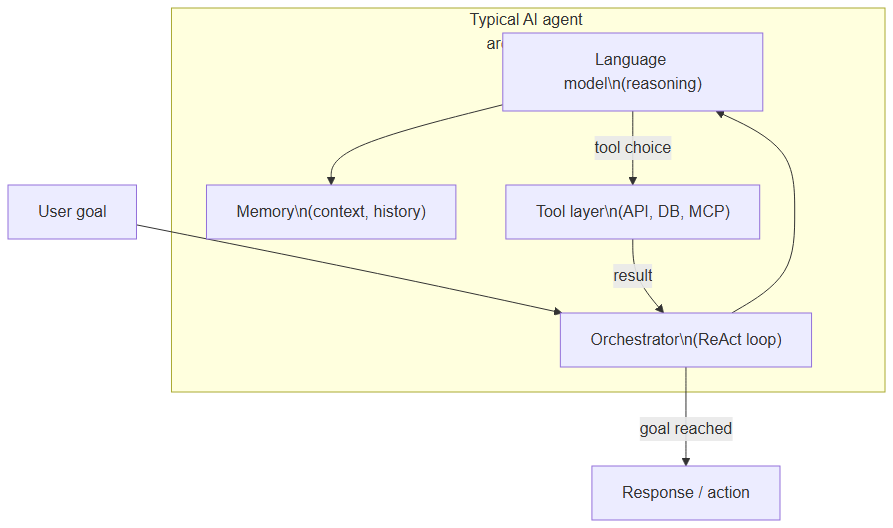 Four components of an AI agent: LLM, memory, tools, and orchestrator in a ReAct loop
Without a framework, you reimplement state management, retries, tool schemas, persistence, and observability by hand. The frameworks below provide those foundations — with different philosophies: stateful graphs, role-based teams, native RAG, strict typing, or automated prompt optimization.
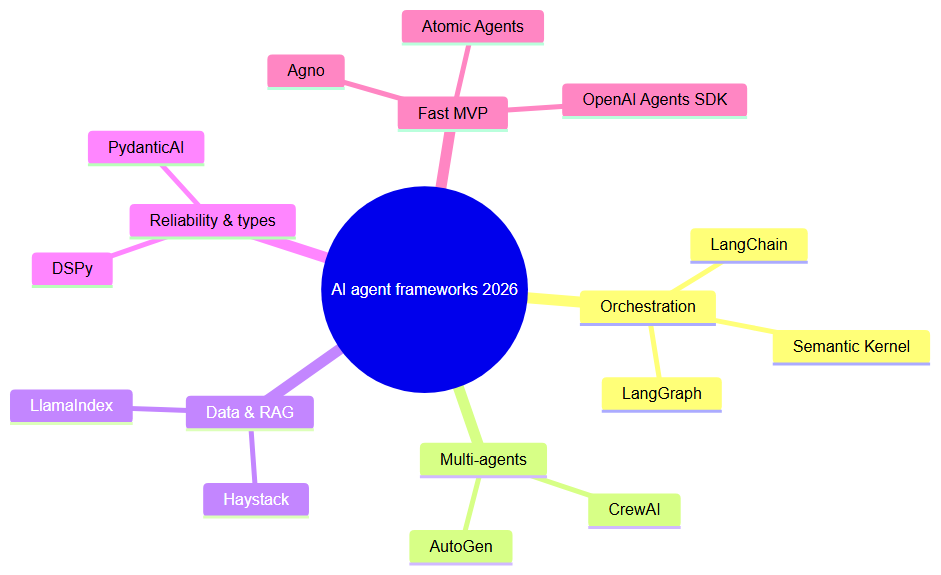 Mind map: orchestration, multi-agents, RAG, reliability, and fast MVP — five framework families
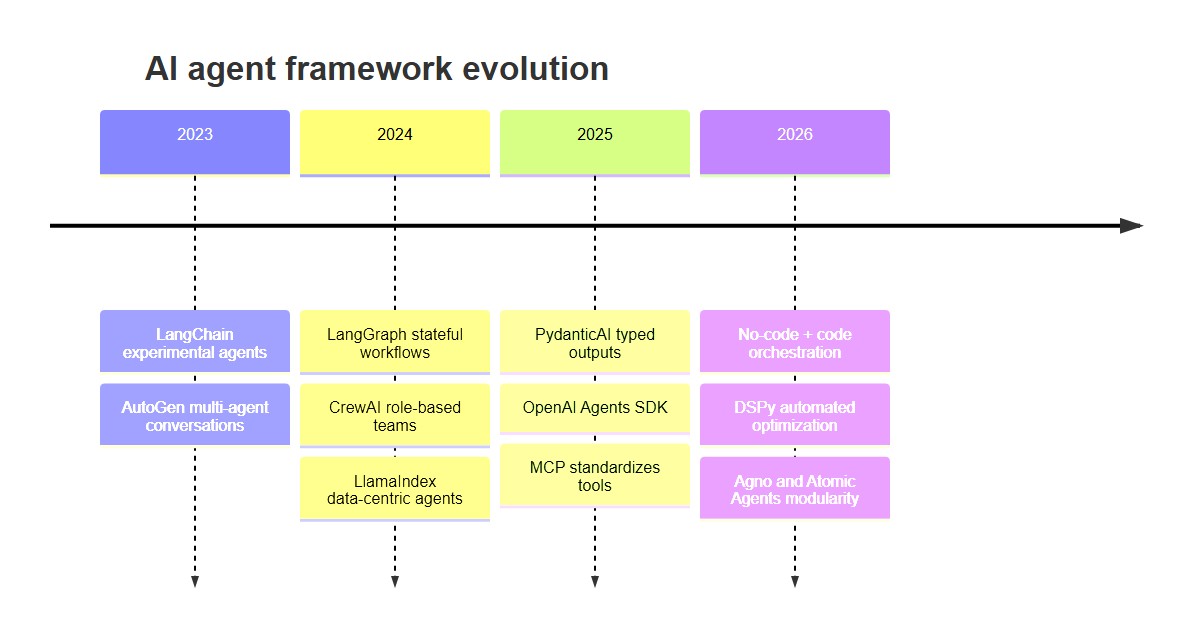 2023–2026 timeline: from experimental LangChain agents to MCP, DSPy, and hybrid no-code + code orchestration
Orchestration and stateful workflows
1. LangGraph
LangGraph has become the reference for production agents within the LangChain ecosystem. It models workflows as directed graphs: nodes (steps), edges (transitions), persistent state, and checkpointing to resume after interruption.
Documented strengths: stateful execution, human-in-the-loop, multi-agent orchestration, durable scalable workflows.
Best for: complex business processes, research assistants, enterprise automation where every conditional branch must be traceable.
Limitation: steeper learning curve than a minimal SDK; graph modeling skills required.
2. LangChain
LangChain remains the most widely adopted toolkit for connecting LLMs to data sources, APIs, and tool chains. It is not agents-only: it also covers linear chains, retrievers, and hundreds of connectors.
Strengths: large community, rich integrations, memory/tool management, rapid prototyping, extensive documentation.
Best for: teams that want flexibility and fast iteration — often combined with LangGraph for stateful agent logic.
Note: n8n builds on LangChain for its AI Agent node, making it a natural bridge between code and visual orchestration. See n8n AI Agent: turn workflows into intelligent systems.
3. Semantic Kernel
Built by Microsoft, Semantic Kernel targets teams invested in .NET and Azure. It blends conventional code with AI via plugins and orchestrated planners.
Strengths: enterprise focus, Microsoft integration, reusable plugins, structured orchestration.
Best for: large-scale business apps, IT departments standardizing on Azure OpenAI and .NET.
Limitation: less ideal if your stack is 100% Python with no Microsoft constraint.
The Multi-Agent Era: Making CrewAI, AutoGen, and LangGraph Collaborate
4. CrewAI
CrewAI popularized agent teams with explicit roles: researcher, strategist, writer, analyst, reviewer. Each agent has a mission; an orchestrator coordinates toward a shared goal.
Strengths: intuitive role architecture, multi-agent collaboration, lightweight implementation, productivity focus.
Best for: content creation, business operations, research projects with natural task division.
In production: combine CrewAI for reasoning with n8n for triggers, queues, and notifications — an architecture we deploy regularly at BOVO Digital.
5. AutoGen
AutoGen (Microsoft Research / open ecosystem) excels at agent-to-agent communication and dynamic conversations involving humans and machines. Agents can debate, refine answers, and run code in controlled environments.
Strengths: multi-agent dialogues, flexible orchestration, human oversight, complex reasoning.
Best for: research automation, coding assistants, decision systems where multiple perspectives improve outcomes.
Limitation: harder to constrain for strict business flows than a fixed-role CrewAI team.
Data, RAG, and enterprise knowledge
6. Haystack
Haystack (deepset) is a reference for retrieval-augmented generation (RAG) and document pipelines. When agents must query large PDF corpora, internal wikis, or vector stores, Haystack structures indexing, retrieval, and generation.
Strengths: advanced retrieval, modular RAG pipelines, vector DB integrations, scalable open-source architecture.
Best for: knowledge management, internal search, document intelligence.
7. LlamaIndex
LlamaIndex evolved from a data indexing framework into a full platform for data-aware agents. It connects LLMs to structured and unstructured sources with varied retrieval strategies.
Strengths: data-centric architecture, advanced indexing, flexible RAG, multi-provider LLM integration.
Best for: research assistants, enterprise search, applications where retrieval quality is everything.
Complementarity: Haystack shines on industrial document pipelines; LlamaIndex on versatile data-aware agents. For RAG and hallucinations, see Your AI is dumb — and that's normal: RAG explained.
Reliability, typing, and optimization
8. PydanticAI
PydanticAI builds on Pydantic for structured, typed outputs. No more malformed JSON: the framework validates model responses before they reach your application.
Strengths: structured generation, Python type safety, simplified debugging, native developer experience.
Best for: agent APIs, data extraction, any flow where invalid output breaks downstream logic.
9. DSPy
DSPy (Stanford) shifts the paradigm: instead of hand-crafted prompts, you define goals and metrics; the framework optimizes model interactions automatically.
Strengths: automated optimization, less manual prompt engineering, measurable iterative improvement.
Best for: advanced systems where performance must improve with evaluation data — more research and data teams than express MVPs.
10. OpenAI Agents SDK
The OpenAI Agents SDK (OpenAI documentation, 2025–2026) offers a minimal surface to build agents with tools, multi-agent handoffs, and integrated tracing on OpenAI models.
Strengths: streamlined developer experience, native tool integration, fast deployment, tracing.
Best for: prototypes and products standardized on OpenAI targeting time-to-market.
Limitation: vendor dependency; plan a multi-provider abstraction layer for critical production (covered in our resilience-focused articles).
Lightweight, modular, and MVP-focused
11. Agno
Agno (formerly Phidata) bets on lightweight setup and speed. Less ceremony than LangGraph, more agent features out of the box than a homegrown script.
Strengths: lightweight architecture, fast setup, strong community-perceived performance, flexible integrations.
Best for: startups, MVPs, agile teams that need a working agent in days.
12. Atomic Agents
Atomic Agents pushes modularity: reusable components assembled like LEGO bricks. The goal is long-term maintainability as systems grow.
Strengths: modular design, reusable components, clean architecture, scalability.
Best for: multi-year projects where several teams touch the same agent foundation.
Code (Python/TS) vs Low-Code (n8n): Which framework to choose?
Selection depends on five axes: orchestration, multi-agents, RAG, output reliability, and delivery speed.
The real duel today isn't just between Python libraries, but between a Code-first approach (which gives absolute freedom but requires maintenance) and a Low-Code approach (like n8n) that lets you plug an agent into your ERP or CRM in minutes without reinventing the wheel. Often, the best B2B architecture involves using LangGraph or CrewAI for the "brain" and n8n for the "arms" (actions).
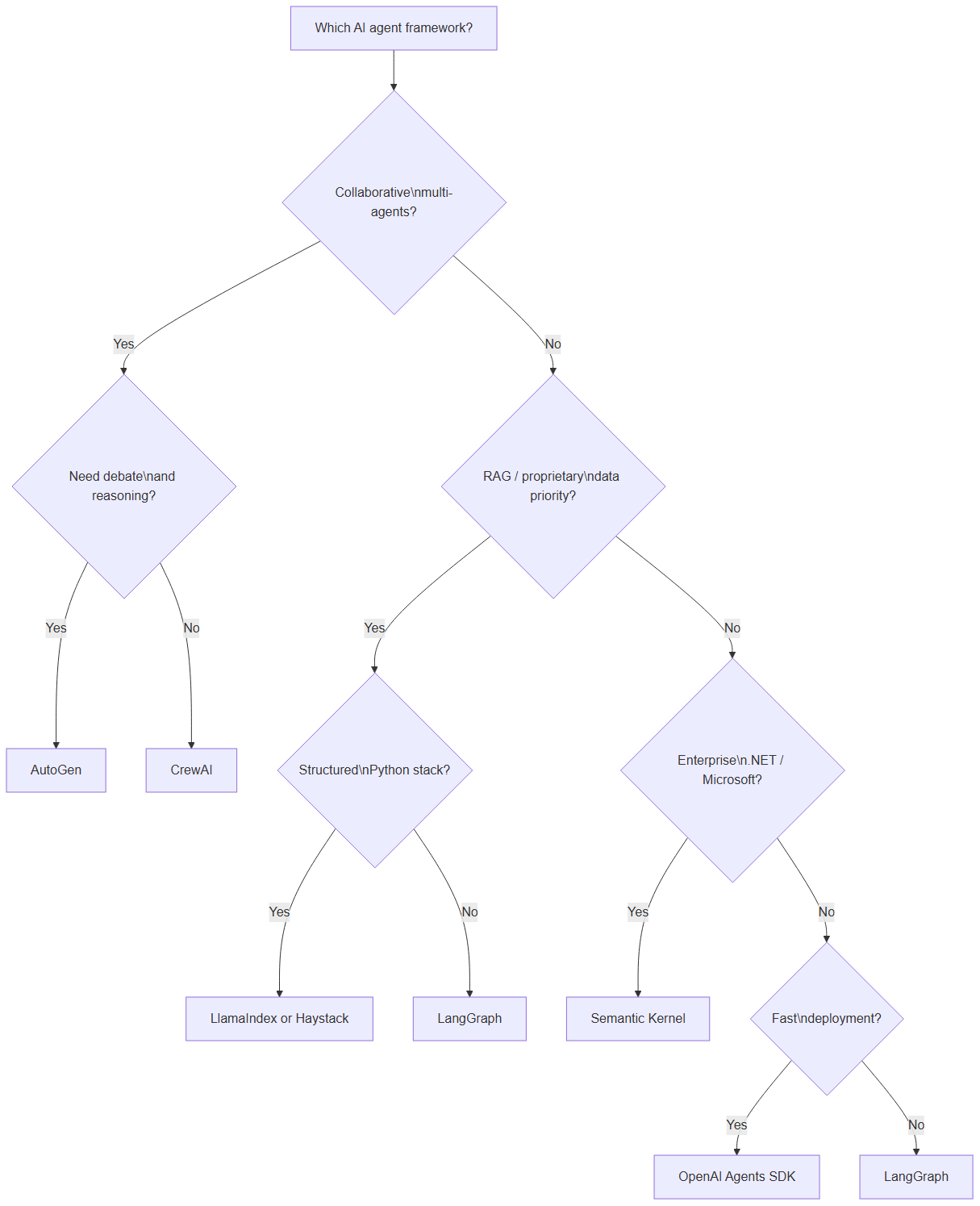 Decision tree: multi-agents, RAG, Microsoft stack, or fast deployment point to the right framework
| Primary need | Frameworks to evaluate first |
|---|---|
| Stateful production workflows | LangGraph, Semantic Kernel |
| Role-based agent teams | CrewAI |
| Dialogue and multi-agent reasoning | AutoGen |
| RAG and documents | Haystack, LlamaIndex |
| Reliable typed outputs | PydanticAI |
| Continuous optimization | DSPy |
| Fast MVP | OpenAI Agents SDK, Agno |
| Long-term modularity | Atomic Agents, LangChain |
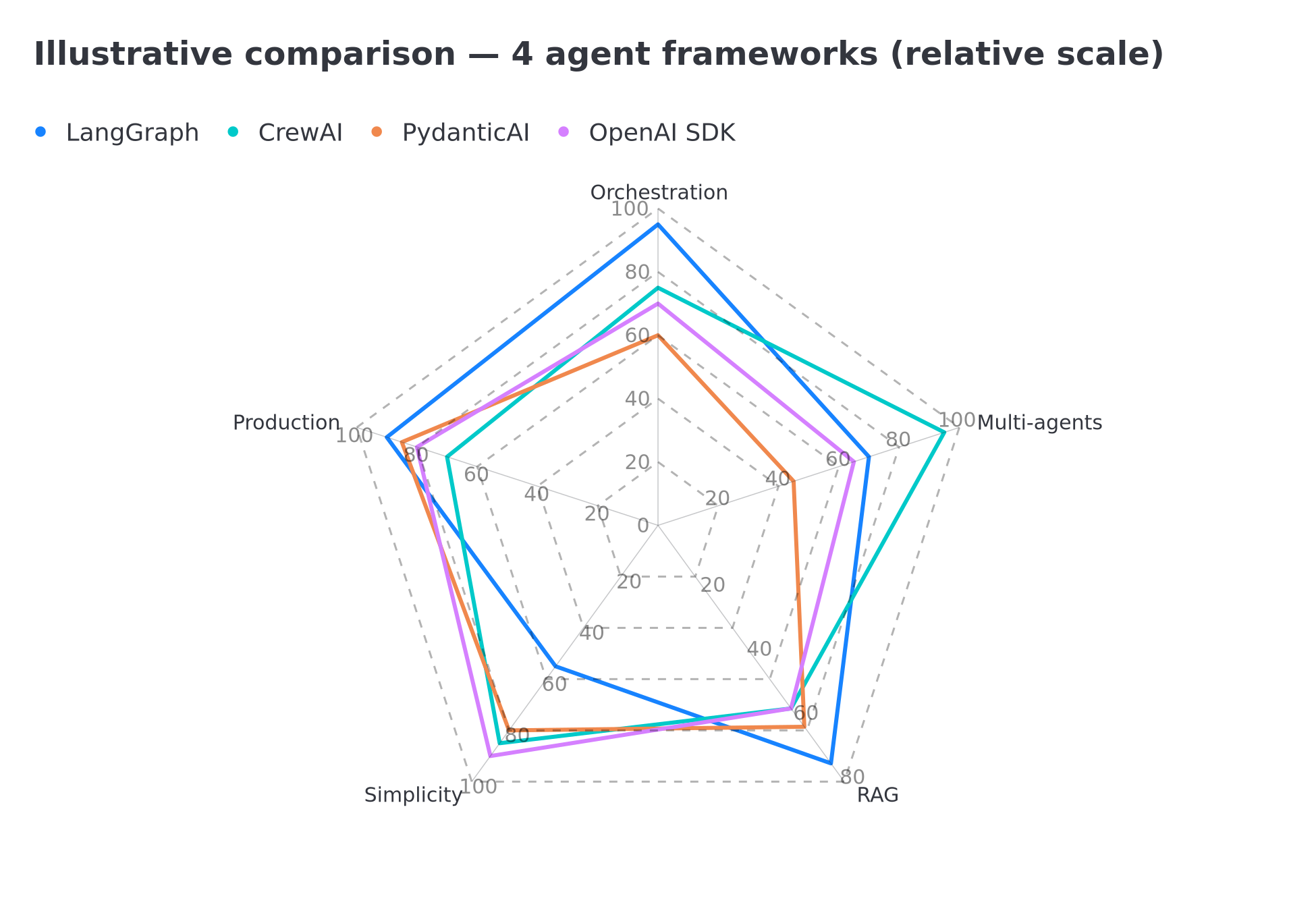 Illustrative radar (relative scale, not an official benchmark): LangGraph, CrewAI, PydanticAI, and OpenAI Agents SDK on orchestration, multi-agents, RAG, simplicity, and production
Methodology note: the radar above is an illustrative visualization to compare profiles, not a third-party published benchmark. Always evaluate on your real use case.
The BOVO Digital angle: code frameworks + n8n / MCP orchestration
At BOVO Digital we do not pit code frameworks against no-code tools. We stack them:
- Code framework (LangGraph, CrewAI, PydanticAI…) for reasoning, fine-grained RAG, or complex business logic.
- MCP server to expose internal tools in a standardized way — see MCP stabilized + A2A protocol.
- n8n (or Make) for triggers, visual orchestration, retries, alerts, and 400+ business app integrations — detailed in Connect n8n to an MCP server and Make AI Agents vs n8n.
This hybrid stack matches what we see in the field: purely code agents struggle with ops (monitoring, scheduling, error handling); purely no-code agents hit ceilings on complex logic. The combination holds up in production.
For a first agent without a custom framework, Tutorial: build your first autonomous AI agent with n8n remains the most accessible entry point.
2026 trends: what comes after frameworks
The agent ecosystem is converging on:
- Long-term memory beyond windowed context
- Multi-step planning with failure recovery
- Real-time tools via MCP and streaming APIs
- Governance: observability, quotas, action auditing
- Interoperability between agents (A2A protocol) and tools (MCP)
The frameworks listed already embed parts of these capabilities. Your job is to pick what matches your technical maturity today while keeping an interchangeable orchestration layer tomorrow.
Conclusion: the framework matters less than the overall architecture
As of June 2026, LangGraph, LangChain, CrewAI, AutoGen, Semantic Kernel, Haystack, PydanticAI, LlamaIndex, OpenAI Agents SDK, DSPy, Agno, and Atomic Agents form the reference landscape for serious AI agents. None covers everything; each optimizes a trade-off.
Key takeaways:
- Stateful production → LangGraph leads the list.
- Readable collaboration → CrewAI.
- Proprietary data → Haystack or LlamaIndex.
- Output reliability → PydanticAI.
- Ship fast → OpenAI Agents SDK or Agno.
- Stay in production → add n8n, MCP, and observability — not just a framework.
The choice you make this week shapes your team's velocity for the next two years. Map your use case, test two finalists on a real scope, then industrialize with orchestration that does not lock you in.
BOVO Digital helps companies with audits, framework selection, MCP + n8n deployment, and production rollout with guardrails. Contact us to scope your first agent in real conditions.
Tags
FAQ
What is the best AI agent framework in 2026?
There is no universally "best" framework. LangGraph excels at stateful production orchestration, CrewAI at role-based multi-agent teams, PydanticAI at reliable typed outputs, and the OpenAI Agents SDK at fast deployment. The right choice depends on your stack, team skills, and whether RAG or multi-agent collaboration is the priority.
What is the difference between LangChain and LangGraph?
LangChain is a broad toolkit for connecting LLMs to data sources and APIs. LangGraph, from the same ecosystem, focuses on graph-based agent workflows: persistent state, conditional branches, loops, and checkpointing. Many production projects combine both.
Should I code an agent or use n8n / Make?
Both approaches complement each other. Code frameworks (LangGraph, CrewAI…) offer flexibility and fine control. n8n or Make provide visual orchestration, triggers, error handling, and 400+ app integrations without rewriting everything. At BOVO Digital we often deploy n8n as the execution layer on top of code frameworks or MCP servers.
CrewAI or AutoGen for a multi-agent project?
CrewAI structures teams with explicit roles (researcher, writer, reviewer) and readable workflows — ideal for business productivity. AutoGen, from the Microsoft Research ecosystem, favors dynamic conversations between agents and humans, suited to research and complex reasoning. CrewAI is faster to set up; AutoGen offers more conversational flexibility.
How do I connect an agent framework to internal tools?
Three dominant paths in 2026: native framework integrations (APIs, vector stores), the MCP protocol for standardized tools, or an orchestration layer like n8n that calls your framework and internal systems. Our n8n + MCP tutorial covers the most robust production approach.
Can BOVO Digital architect our AI agent stack?
Yes. We audit your use case, select the right framework, connect your data via MCP or RAG, and deploy orchestration on n8n or Make with monitoring, guardrails, and documentation. Typical delivery in 2–4 weeks depending on complexity.
We scope one workflow — not a generic demo
You describe a repeated task. We tell you what n8n would ship, the timeline, and what stays out of scope.
- 30 min
- 1 scoped workflow
- No commitment
Singbo Davy AGONMA
Fullstack Developer & AI Expert. n8n automation specialist, Laravel/Flutter development and AI agent integration. Master CS — IFRI.


