
Anthropic vs the Pentagon: When AI Refuses War — Impact on Your Business
Anthropic refused to lift ethical restrictions for military use of Claude. Result: exclusion from US federal agencies. What does this mean for the reliability and ethics of your automation tools?
Updated

Anthropic vs the Pentagon: When AI Refuses War — Impact on Your Business
On February 27, 2026, news shook the tech world. Anthropic, the company behind Claude (one of the most widely used AI models in the world), was excluded from all US federal agencies by order of the Trump administration. The reason? Anthropic refused to lift its ethical safeguards regarding military use of its AI.
This decision has repercussions far beyond Washington. If you use Claude in your automation workflows, chatbots, or content generation systems, this event directly concerns you. To understand the full competitive landscape around this decision — and in particular why Google and NVIDIA made radically different choices — see our dedicated analysis: Pentagon AI military: Google and NVIDIA say yes, Anthropic says no.
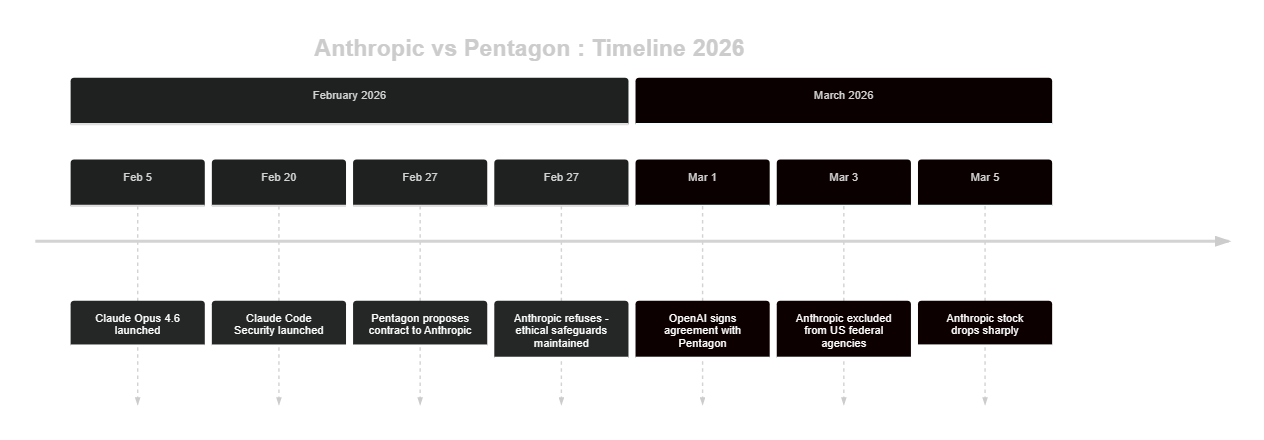 February–March 2026: key events around Anthropic and the Pentagon
What Happened: The Timeline
The Pentagon's Offer
The US Department of Defense proposed a contract to Anthropic similar to the one signed with OpenAI: deploy Claude in classified military systems, with supervision conditions.
Anthropic's Refusal
Anthropic refused to budge on three fundamental points:
- No mass surveillance via AI
- No fully autonomous weapons using Claude
- Maintaining all ethical restrictions defined in their Responsible Scaling Policy
Immediate Consequences
- Exclusion of Claude from all US federal agencies
- OpenAI captures the market (agreement signed with the Pentagon)
- Anthropic stock drops sharply (investors worried)
OpenAI vs Anthropic: Which Vision of AI Ethics Will Prevail?
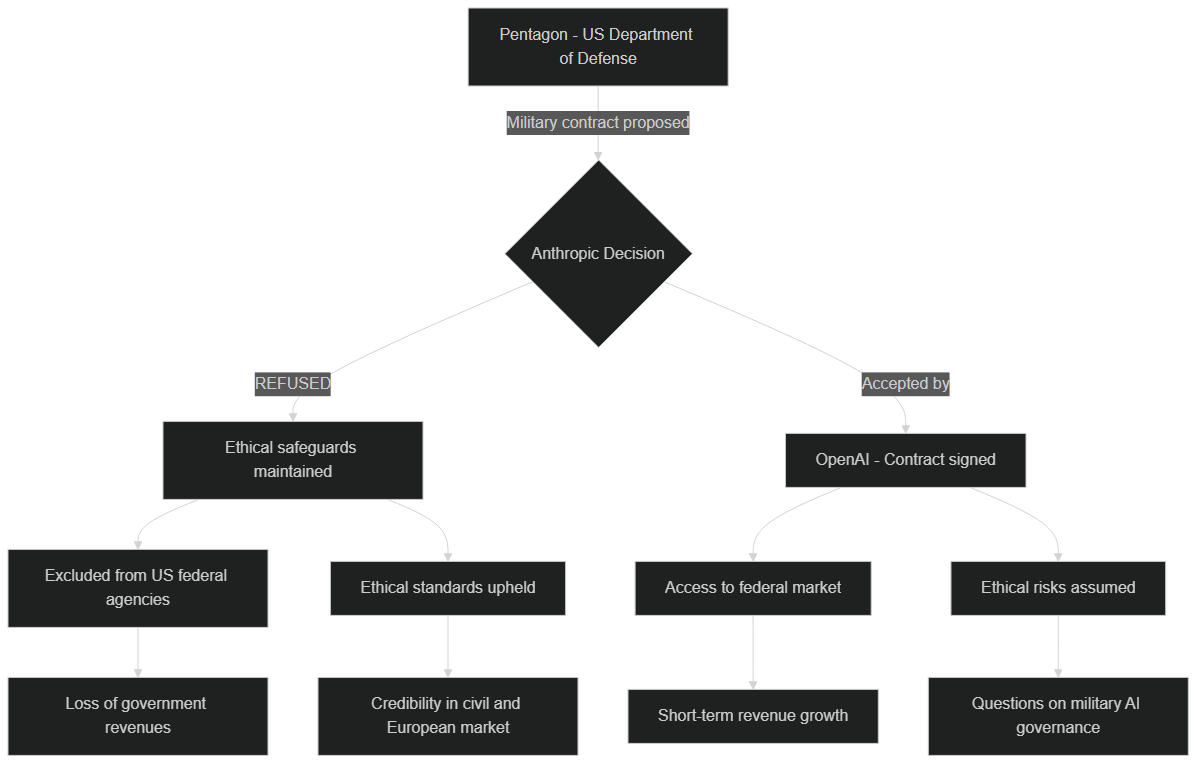 OpenAI vs Anthropic on military AI use — only the ban on autonomous weapons is shared
| Aspect | OpenAI | Anthropic |
|---|---|---|
| Military use | ✅ Accepted (with safeguards) | ❌ Categorically refused |
| Autonomous weapons | ❌ Prohibited | ❌ Prohibited |
| Surveillance | ⚠️ Case by case | ❌ Refused |
| Pentagon contract | ✅ Signed | ❌ Rejected |
| Business impact | Government growth | Loss of US federal market |
Anthropic's Mission: AI Safety as a Founding Principle
To understand why Anthropic made such a commercially costly decision, we need to trace the company back to its origins. Founded in 2021 by Dario Amodei, Daniela Amodei, and several former OpenAI colleagues, Anthropic was deliberately designed with a different mission: not simply to build the world's most powerful AI, but to build the safest and most beneficial one over the long term.
This orientation is not marketing speak. It translates into massive investments in AI safety — the discipline that seeks to ensure AI systems remain aligned with human values as they become more capable. In our reading of Anthropic's public communications, the company believes the most serious risk is not that an AI will become "malevolent" on its own, but that it will be used by human actors for harmful purposes — mass surveillance, targeted disinformation, autonomous weapons systems.
From this perspective, accepting a classified military contract without full editorial control would have constituted a direct contradiction of the company's reason for being. Dario Amodei has stated this publicly: yielding on military safeguards would not merely have been a commercially risky decision — it would have meant abandoning the fundamental promise made to employees, ethical investors, and the public that trusts them.
This positioning inevitably creates tension between mission and economic viability. A company whose valuation depends on massive fundraising rounds (Anthropic has raised several billion dollars from Amazon, Google Ventures, and growth funds) cannot indefinitely ignore lucrative markets. But in our analysis, it is precisely this risky bet that constitutes Anthropic's distinctive value proposition in the civil market: being the only major AI to have said no when everyone else said yes.
Constitutional AI: Anthropic's Unique Governance Framework
The term "Constitutional AI" is not a poetic metaphor — it is the name of a research technique published by Anthropic and applied directly to Claude's training. Unlike classical approaches that attempt to correct an AI's behaviors after the fact, Constitutional AI integrates values directly into the learning process.
In practice, it works as follows: Claude is trained with a "constitution" — a set of principles articulating what is honest, harmless, and helpful. At each stage of training, the model learns to self-critique: it generates responses, evaluates whether they comply with the constitution, then self-corrects. This self-revision process is not superficial; it creates deep inhibitions that subsequent user requests cannot easily circumvent.
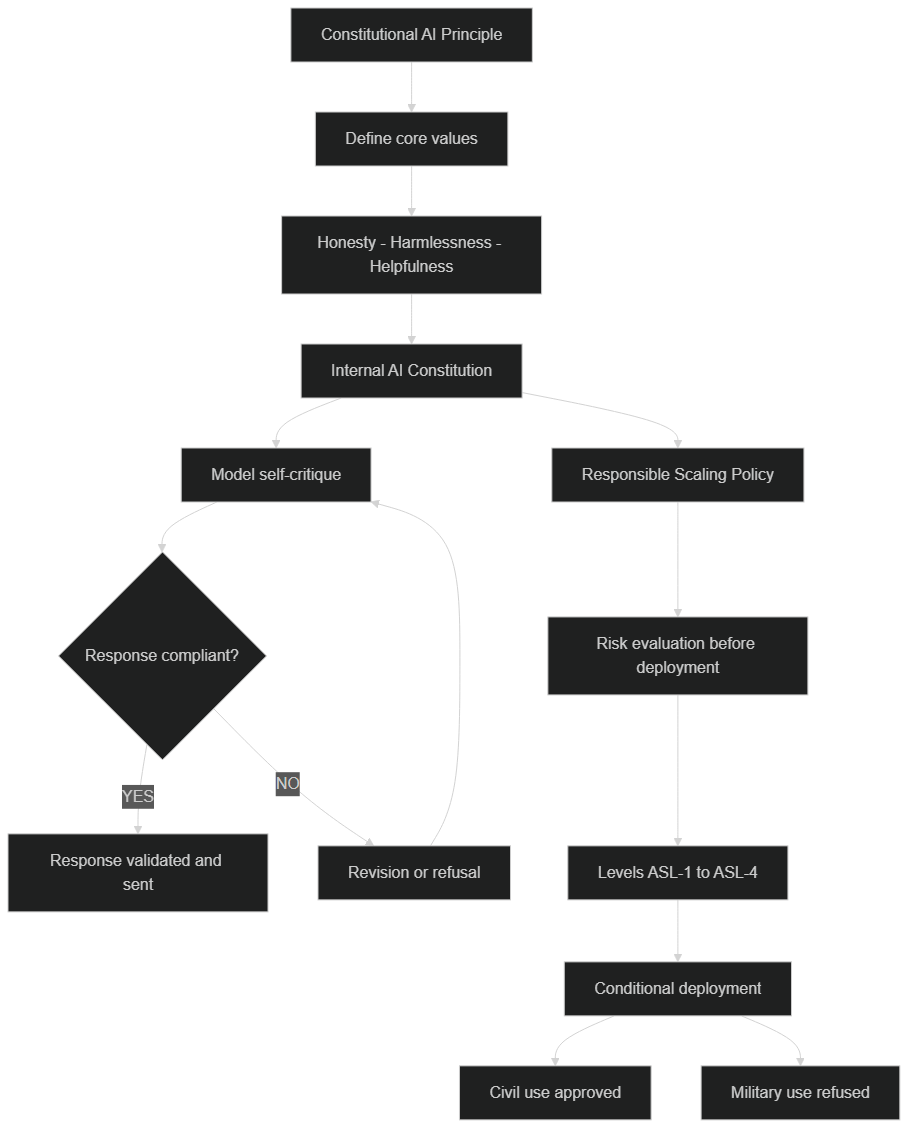 The Constitutional AI process: how Anthropic integrates values into Claude's core architecture
The Responsible Scaling Policy (RSP) is the operational corollary of this approach. It defines escalating risk levels, from ASL-1 (minimal risks) to ASL-4 (potential existential risks), and sets the conditions under which Claude can be deployed at each level. Autonomous military or mass surveillance applications fall into categories for which Anthropic believes the necessary safety measures cannot yet be guaranteed.
For companies using Claude in their workflows, this framework has concrete implications. The robustness of these constitutional inhibitions means Claude is structurally less likely to produce problematic responses — serious hallucinations, harmful content, discriminatory biases — in your business applications. This is a direct advantage for companies subject to the European AI Act or sector-specific obligations (healthcare, finance, HR). To avoid hallucination risks in your automations, see our practical guide: Avoiding AI hallucinations: complete guide for businesses.
Google, NVIDIA, Microsoft: The Acceptance Camp
Anthropic is not the only tech company to have had to take a position on military requests. But unlike its competitors, it is the only major lab to have maintained an intransigent line. Understanding the choices of other players illuminates the singularity of Anthropic's position.
Google had a painful precedent with Project Maven in 2018: faced with massive employee protests denouncing participation in a military drone program, the company was forced to abandon the contract. But since then, Google has progressively reopened its doors to the defense sector. In 2024, Google DeepMind accepted contracts with the UK Ministry of Defense, and Google Cloud continues to provide services to US government agencies, including intelligence agencies.
NVIDIA has never claimed any particular ethical neutrality regarding its GPUs. The company supplies graphics processors that power civilian data centers as well as defense and intelligence systems worldwide. Its logic is that of a component manufacturer: responsibility for end use belongs to the buyer. This position is consistent but raises questions about the chain of responsibility in military AI.
Microsoft made the opposite choice to Anthropic by signing a $10 billion contract with the Pentagon (Azure Government) and integrating its AI models (via the OpenAI partnership) into classified military environments. Microsoft President Brad Smith explicitly stated that the company believed it had "a responsibility to support the defense of democracies."
This divergence in positioning between actors illustrates the absence of industry consensus on what ethical governance of military AI should look like. For a detailed comparison of different AI labs' approaches to these questions, our article Pentagon AI military: Google and NVIDIA say yes, Anthropic says no offers an in-depth analysis.
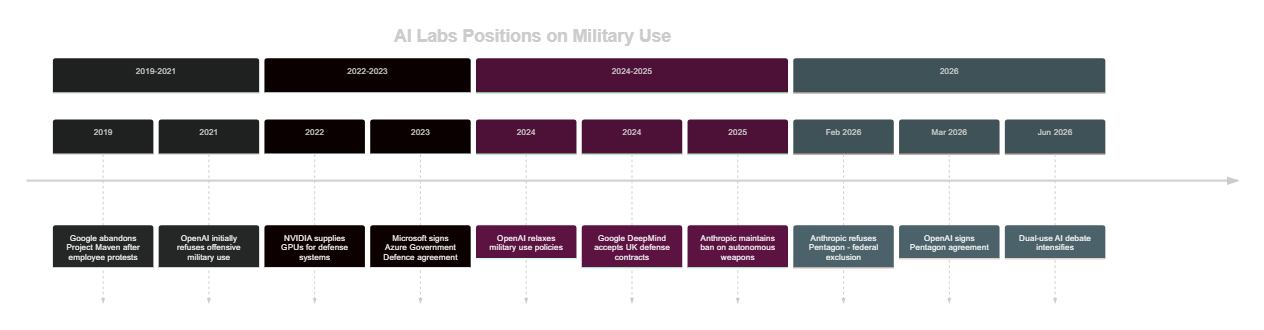 From Project Maven to the OpenAI-Pentagon agreement: how AI labs have evolved on military use
The "Dual Use" Debate: Can AI Really Remain Neutral?
One of the most frequently cited arguments by those who criticize Anthropic's decision is that of "dual use" — the idea that any sufficiently powerful technology can be used for both civilian and military purposes, and that attempting to erect a watertight boundary between the two is illusory.
This argument deserves to be taken seriously. An advanced language model like Claude can, without modification, be used to write medical reports, analyze legal contracts, or generate sophisticated cyberattack plans. The same capacity to understand and produce complex text that makes Claude an excellent productivity assistant also makes it, potentially, a tool for propaganda, social engineering, or strategic planning.
Advocates for AI military engagement argue that if democracies do not equip their armed forces with the best available technologies, they risk finding themselves at an inferior position relative to less scrupulous adversaries — China and Russia foremost among them, whose military AI programs face no comparable ethical restrictions.
On the other side, supporters of Anthropic's position argue that the speed at which AI is progressing creates specific risks that urgently need to be managed before deploying them in irreversible military contexts. Autonomous weapons systems cannot be "recalled" like a software update in case of error. The consequences of unexpected behavior or adversarial manipulation in a combat context can be catastrophic and permanent.
In our reading of the situation, the truth likely lies in a space of nuance that is difficult to inhabit politically but intellectually honest: some military applications of AI (logistics, open-source intelligence analysis, field medicine) present very different risk profiles from autonomous weapons systems. The challenge is establishing governance frameworks fine-grained enough to distinguish between these categories — a task that neither governments nor technology companies have yet satisfactorily resolved.
For and Against: A Balanced Analysis of Anthropic's Refusal
It would be reductive to present Anthropic's refusal as an act of heroic bravery without counterpart, or as a naive strategic error. Both perspectives have merit.
Arguments in favor of the refusal:
Institutional coherence may be the strongest argument. A company that abandons its founding principles as soon as sufficiently large sums are involved sends a disturbing signal about the reliability of its future commitments. By maintaining its position despite the commercial cost, Anthropic has established proof by action that its safeguards are non-negotiable — which is precisely what civil companies and regulators want to hear.
The impact on talent attraction and retention is also real. In a sector where AI engineers can choose from dozens of employers, a company's ethical culture plays a growing role in career decisions. Several Anthropic employees have publicly expressed relief at the military contract refusal, emphasizing that this decision reinforces their choice of employer.
Finally, in the context of the European AI Act and upcoming regulations in other jurisdictions, companies that demonstrate a track record of rigorous ethical governance will be better positioned to obtain certifications and regulated market access.
Arguments against the refusal:
The lost influence argument deserves attention. By refusing to engage with the Pentagon, Anthropic also gives up any possibility of influencing how military AI will be developed and deployed. OpenAI, by accepting, may have more influence over supervision protocols and operational safeguards than if it had refused.
The economic viability risk is concrete. The US federal market represents tens of billions of dollars in AI opportunities. By self-excluding, Anthropic makes its path to profitability more difficult, creating increased dependence on private investors and, potentially, future pressure to relax its standards.
Finally, the question of symbolic effectiveness arises: if Western democracies deploy less safe military AIs because the best ones are unavailable, is the net balance in terms of global security genuinely positive?
Commercial Impact: Losses, Gains, and Long-Term Resilience
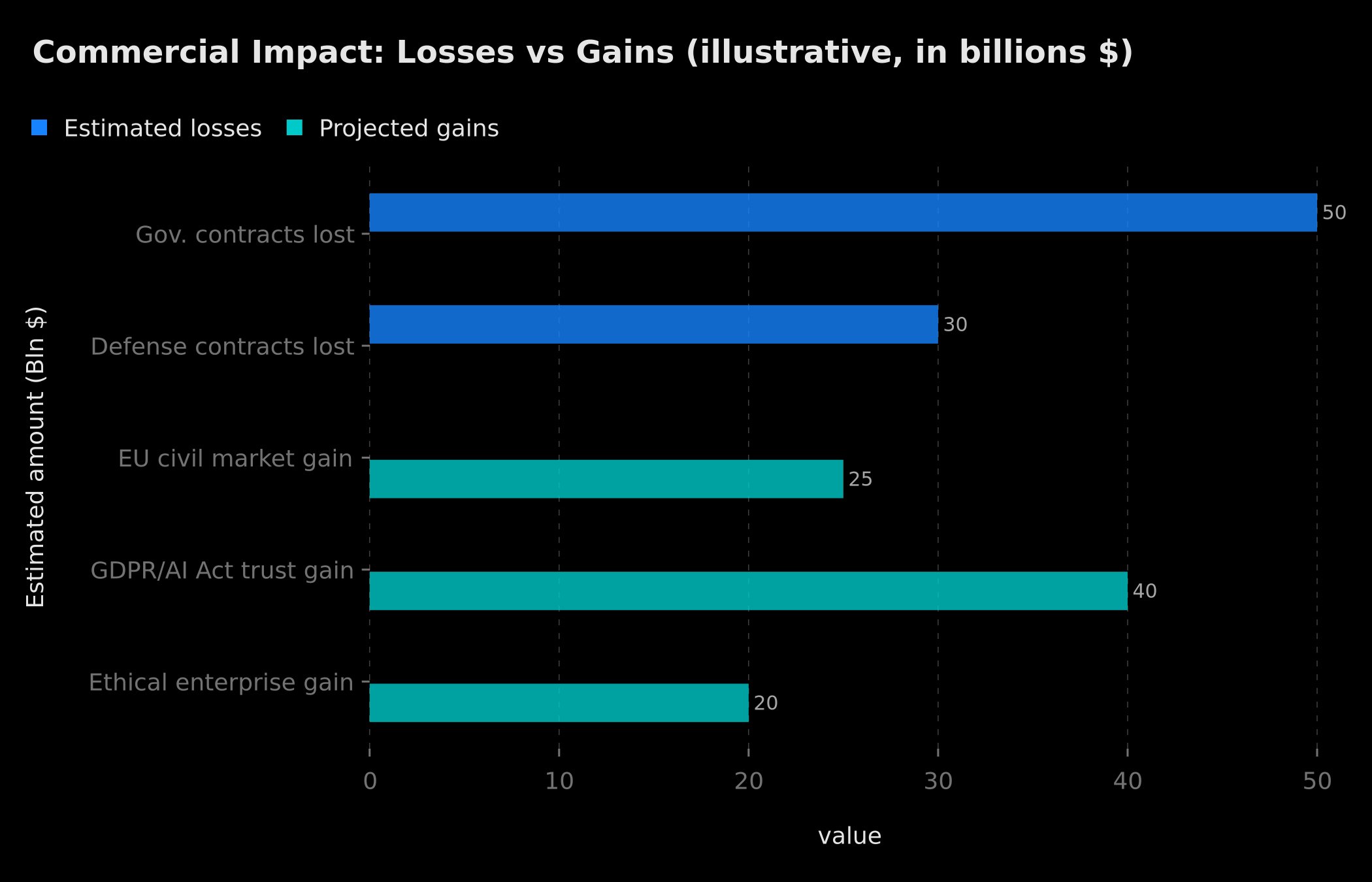 Illustrative analysis of Anthropic's commercial impact: lost markets and gained opportunities (estimated order of magnitude)
The exact figures for lost contracts are not public, but in our reading of available sector analyses, the loss of the US federal market is measured in billions of dollars of opportunities over five years. OpenAI, which accepted the Pentagon contract, immediately consolidated its position as the reference government provider, with all the commercial synergies that implies (references, FedRAMP certifications, access to specialized training data).
In exchange, Anthropic's ethical positioning creates real opportunities in other markets. In Europe, where the AI Act imposes transparency and governance requirements without American equivalent, companies are looking for AI providers whose philosophy is compatible with a strict regulatory environment. Anthropic's track record of refusing ethical compromises is a direct commercial argument to these clients.
In financial, medical, and legal sectors — industries where AI errors can have serious consequences and where regulators demand high levels of reliability and traceability — Anthropic's reputation as a responsible actor is a differentiator. Companies integrating Claude into sensitive workflows benefit from working with a partner whose past behavior indicates they will not sacrifice safety for growth.
The question of financial survival remains open nonetheless. Anthropic still depends heavily on investors to finance its operations. As long as Claude is not profitable at scale, commercial pressure will exist. For companies considering integrating Claude into their tools, monitoring Anthropic's financial evolution is relevant — and maintaining a resilient multi-model architecture is prudent. To compare costs and capabilities of different AI models available for your business, our guide AI chatbot quote 2026: how much does a ChatGPT or Claude chatbot cost provides concrete elements.
Why This Directly Concerns You
1. Your AI Stack Reliability
If your business uses Claude (via API, in n8n, via Make, or directly), this situation raises a strategic question: how resilient is your stack?
- Claude remains commercially available, but the loss of the federal market could affect Anthropic's revenues.
- Long-term, Anthropic needs large contracts to fund R&D for its models.
- Recommendation: Always implement a multi-model fallback (Claude + GPT-4 + Gemini).
2. Ethics as a Competitive Advantage
Paradoxically, Anthropic's refusal is also a signal of reliability:
- A company that refuses billions of dollars for its principles is predictable.
- Their strict safeguards mean Claude is less likely to generate problematic content in your applications.
- For European companies subject to GDPR and the AI Act, Anthropic's standards are an asset.
3. Claude Code Security: The New Feature
Alongside this crisis, Anthropic launched Claude Code Security (February 20, 2026):
- Automatic code base analysis to identify vulnerabilities
- Security fix suggestions
- Available in early access for enterprise and team customers
A clear signal: Anthropic is pivoting toward the private B2B market.
What This Concretely Changes for Claude Users
For developers and companies integrating Claude into their systems, several practical implications deserve attention.
First, the API usage terms for Claude have not changed for civil uses. Your automations, chatbots, content generation pipelines, and AI agents continue to function normally. The exclusion concerns US federal agencies, not private companies.
Second, Claude's risk profile may be one of the most favorable on the market for sensitive professional applications. The rigor of Constitutional AI and the Responsible Scaling Policy create inhibitions that protect your applications from the most problematic behaviors. To deepen how to avoid hallucination risks in your workflows, our guide Avoiding AI hallucinations: complete guide for businesses details best practices.
Third, the talent war Anthropic is waging — by maintaining a strong ethical culture — could translate into better model quality over time. The world's best AI safety researchers often choose their employers based on mission alignment. By maintaining this course, Anthropic maximizes its chances of attracting the profiles working on the deepest and most durable improvements in model quality and safety.
Claude Opus 4.6: What Changes for Your Automations
Despite the political crisis, Anthropic continues to deliver. Claude Opus 4.6, launched February 5, 2026, brings:
- 1 million token context window (beta) — Processing massive documents
- Improved reasoning — Excels in code and research benchmarks
- Optimized speed — Response time reduced by 30%
Concrete impact for your workflows:
- n8n: AI agents using Claude can now process 500+ page documents in a single pass
- Make: Long content generation scenarios are more reliable
- Chatbots: Longer conversations without context loss
The Mexican Hack: A Warning
A parallel event deserves attention: between December 2025 and January 2026, a hacker used Claude to orchestrate cyberattacks against Mexican government agencies, stealing sensitive data.
Anthropic's Response:
- Immediate investigation
- Implicated accounts banned
- Opus 4.6 updated to detect this type of attack
- Security filters strengthened
The lesson: Even the most "ethical" AI can be misused. Supervision remains indispensable (see our article on AI supervision).
Perspectives: Toward Global Military AI Governance?
Anthropic's decision is part of a much broader debate that, in our analysis, will only intensify in coming years. Several dynamics deserve monitoring to understand how the sector will evolve by 2030.
First, international regulatory pressure. The European Union is actively working on AI governance frameworks for military use in the context of its common defense policy. If these regulations impose transparency and auditability requirements on military AI systems, positions like Anthropic's could become competitive advantages for European defense markets.
Next, the AI arms race. Several reports from specialized think tanks (Georgetown CSET, RAND Corporation) indicate that China is investing massively in military AI without the ethical restrictions characterizing certain Western actors. This creates growing pressure on democratic governments to accelerate their own capabilities — and thus exercise increasing pressure on AI labs to cooperate. Anthropic's position will likely be tested repeatedly.
The question of defining "military" will also grow more complex. Open-source intelligence (OSINT) applications, disinformation analysis, passive cyberdefense, or medical support to armed forces occupy gray zones that the simple civil/military binary cannot resolve. Future versions of Anthropic's Responsible Scaling Policy will likely need to refine these distinctions.
Finally, the evolution of competitors like DeepSeek and GPT-5.5 creates competitive technical pressure on Anthropic independent of its ethical choices. If its models are perceived as technically inferior, ethical positioning will not be sufficient to maintain market share. For a comparison of the strengths and weaknesses of different models in this race, our analysis DeepSeek V4 vs GPT-5.5: open vs closed AI war 2026 offers valuable insight.
How to Adapt Your Strategy
Short term (March 2026)
- Audit your dependency on Claude vs GPT vs Gemini
- Test Claude Opus 4.6 to take advantage of the 1M token window
- Enable Claude Code Security if you're an enterprise customer
Medium term (Q2 2026)
- Multi-model architecture: Never depend on a single provider
- Monitor Anthropic's financial health (lost federal revenues matter)
- Leverage the ethical angle: If you serve European clients, Anthropic's compliance is a commercial argument
Conclusion: AI in a Technological Cold War
We are living through a pivotal moment. AI is no longer just a technological tool — it is a first-order geopolitical issue. Anthropic's choice to refuse the Pentagon's military contract is brave but commercially risky. It reflects a deep conviction that the long-term value of an AI model lies as much in the trust it inspires as in its raw technical capabilities.
For companies betting on intelligent automation, this story illustrates a fundamental principle: the reliability of a technology partner is measured in its moments of resistance, not only in its moments of growth. Anthropic chose coherence. Whether one approves of this decision or not, it makes the company more legible — and therefore easier to evaluate as a long-term partner.
For you, entrepreneur or developer, the message is clear: diversify your AI sources, monitor geopolitical developments, and above all, never put all your eggs in the same algorithmic basket. To follow how models evolve month by month, see our tech recap for February 2026 and our analysis of the week of April 7, 2026.
At BOVO Digital, we build multi-model automation systems resistant to disruptions. Claude, GPT-4, Gemini: we integrate the best of each model into your workflows. Contact us for a resilient AI architecture.
Tags
FAQ
How much does a custom n8n or Make automation cost?
Costs vary by workflow complexity: between €500 and €5,000 for a turnkey project. BOVO Digital offers a free audit to accurately estimate your project before any commitment.
Do I need technical skills to automate my processes?
No. Tools like n8n and Make offer visual interfaces accessible to non-developers. For advanced automations with AI agents, BOVO Digital handles the architecture and deployment, with training included.
How quickly can I see ROI from automation?
Most of our clients see a return on investment within 1 to 3 months. An automation saving 10 hours per week at €40/h generates €1,600/month in value — the investment is typically recouped within a few weeks.
Does Anthropic's refusal to work with the Pentagon affect access to Claude for private businesses?
No. Claude remains fully available for private companies, startups, and developers via the Anthropic API and partner platforms. Only access for US federal agencies has been restricted. For your civil automations, there is no operational impact to report at this time.
What is Anthropic's Constitutional AI and how does it protect my applications?
Constitutional AI is Anthropic's internal governance framework that requires Claude to self-evaluate every response against a "constitution" of values (honesty, harmlessness, helpfulness). In practice, this reduces the risk of harmful content generation, dangerous hallucinations, and biases in your business applications. It is a direct advantage for companies subject to the European AI Act.
We scope one workflow — not a generic demo
You describe a repeated task. We tell you what n8n would ship, the timeline, and what stays out of scope.
- 30 min
- 1 scoped workflow
- No commitment
William Aklamavo
Web development and automation expert, passionate about technological innovation and digital entrepreneurship.


