
n8n vs Zapier: Complete Comparison 2026 — Which One to Choose?
n8n vs Zapier 2026: billing, integrations, self-host. 14 Make / 6 n8n files; Zapier is not in the register. BOVO method and evidence, 13 September 2026.

Updated

n8n vs Zapier: Complete Comparison 2026 — Which One to Choose?
Zapier gets you started in thirty minutes. n8n takes you much further. The whole question is knowing how far you want to go.
n8n vs Zapier is, in 2026, the entry debate in no-code automation. Both platforms connect apps. They do not share the contract: proprietary SaaS billed per task on one side, an open-source engine billed per execution (or VPS) on the other.
This page stays on Zapier. The n8n vs Make match (per-operation price, self-host, volume, integrations) is already written: n8n vs Make complete comparison 2026. We do not redo it.
This 13 September 2026 revision rests on 25 documented automation cases. 14 files name Make.com, 6 name n8n. Zapier appears in no register file: we do not invent a Zapier count, nor “103 projects”.
Method and sample limits
Collection date: 13 September 2026.
Source: 44 files in portfolioData.fr.ts. Automation filter → 25 cases.
Out of scope: CRM, CSVs, emails, named quotes, ComeUp prices.
Public threshold: 5 cases before an aggregate. Make (14) and n8n (6) clear it. Python (3) does not. Zapier: 0 files — no aggregate.
Lines such as “40 hours/month” or “−95% errors” are not recalculated here.
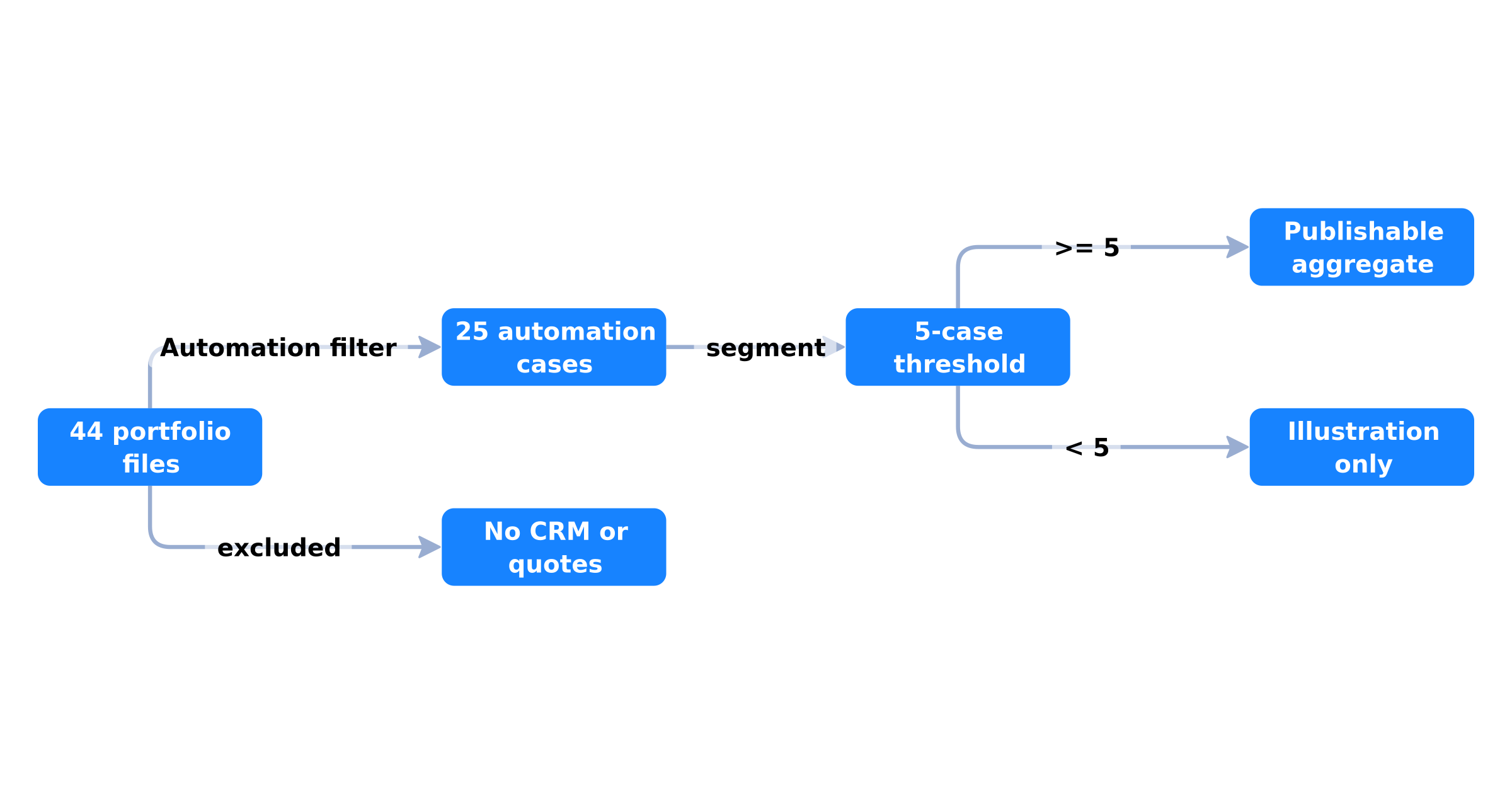 From the public portfolio to an aggregate: 44 files, 25 cases, 5-case threshold, no CRM or quotes
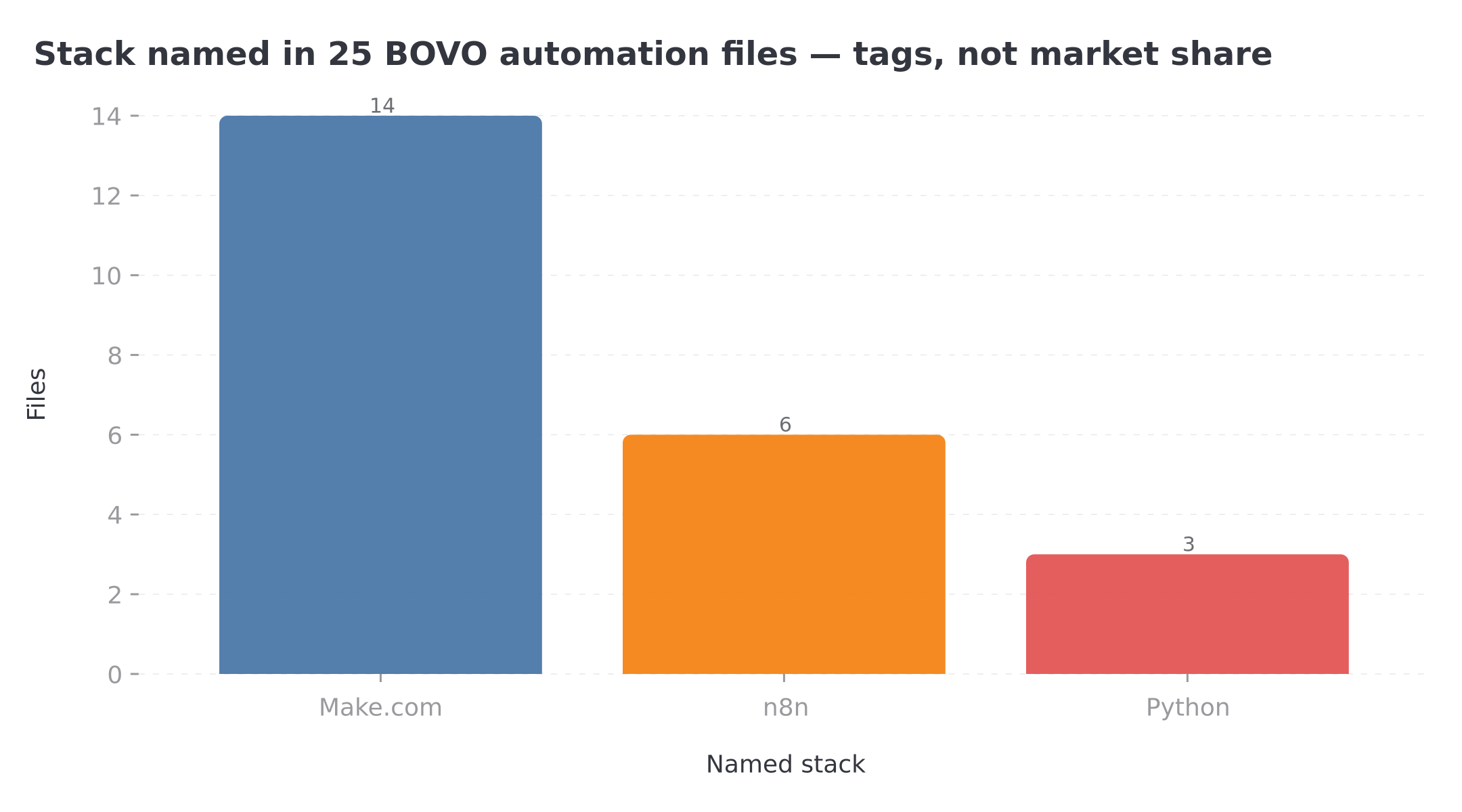 Make.com appears in 14 files, n8n in 6, Python in 3 — technology tags. Zapier is not in the register
Pricing tiers and integration counts are vendor figures. They change. Read the official pages.
n8n vs Zapier: what is the fundamental difference?
Before comparing features, you need to understand that these two tools do not share the same worldview. Everything else — pricing, limits, extensibility — flows from that initial choice.
n8n: open-source, self-hostable automation
n8n (pronounced "n-eight-n", for nodemation) is an open-source automation engine released under a "source-available" license (the Sustainable Use License). In practice, you can download the code, install it on your own server and run as many workflows as your machine allows, without paying any usage license. n8n also offers a managed Cloud plan for those who would rather not run infrastructure.
This open-source nature changes everything: you keep control of your data, you are not locked into a vendor, and you can customize the tool's behavior all the way down to the code. This is the "you own your automation" approach.
Zapier: the turnkey SaaS
Zapier is the opposite: a proprietary online service, fully hosted by the vendor. You manage no server, no updates, no database. You create an account, connect your apps, build a "Zap" (a workflow), and it runs. The trade-off: your data flows through Zapier's infrastructure, you depend on their pricing, and your flexibility stops where the product stops.
A historical pioneer of the space, Zapier built its reputation on one thing nobody truly matches: the number of ready-to-use integrations and a formidable ease of use. This is the "you rent your automation, but with zero friction" approach.
Overview: n8n vs Zapier at a glance
| Criterion | n8n | Zapier |
|---|---|---|
| Type | Open source + managed Cloud | Proprietary SaaS |
| Hosting | Self-hosting or Cloud | Cloud only |
| Billing model | Per execution (Cloud) / free (self-hosted) | Per task |
| Learning curve | Moderate | Very low |
| Native integrations | Hundreds of nodes + universal HTTP | Thousands of apps |
| Native AI agents | Yes (advanced, LangChain-based) | Partial, ramping up |
| Custom code | JavaScript / Python, custom nodes | Limited (Code steps) |
| Data sovereignty | Full when self-hosted | Data lives at Zapier |
| Best for | Volume, AI, sensitive data, cost control | Fast start, rare integrations |
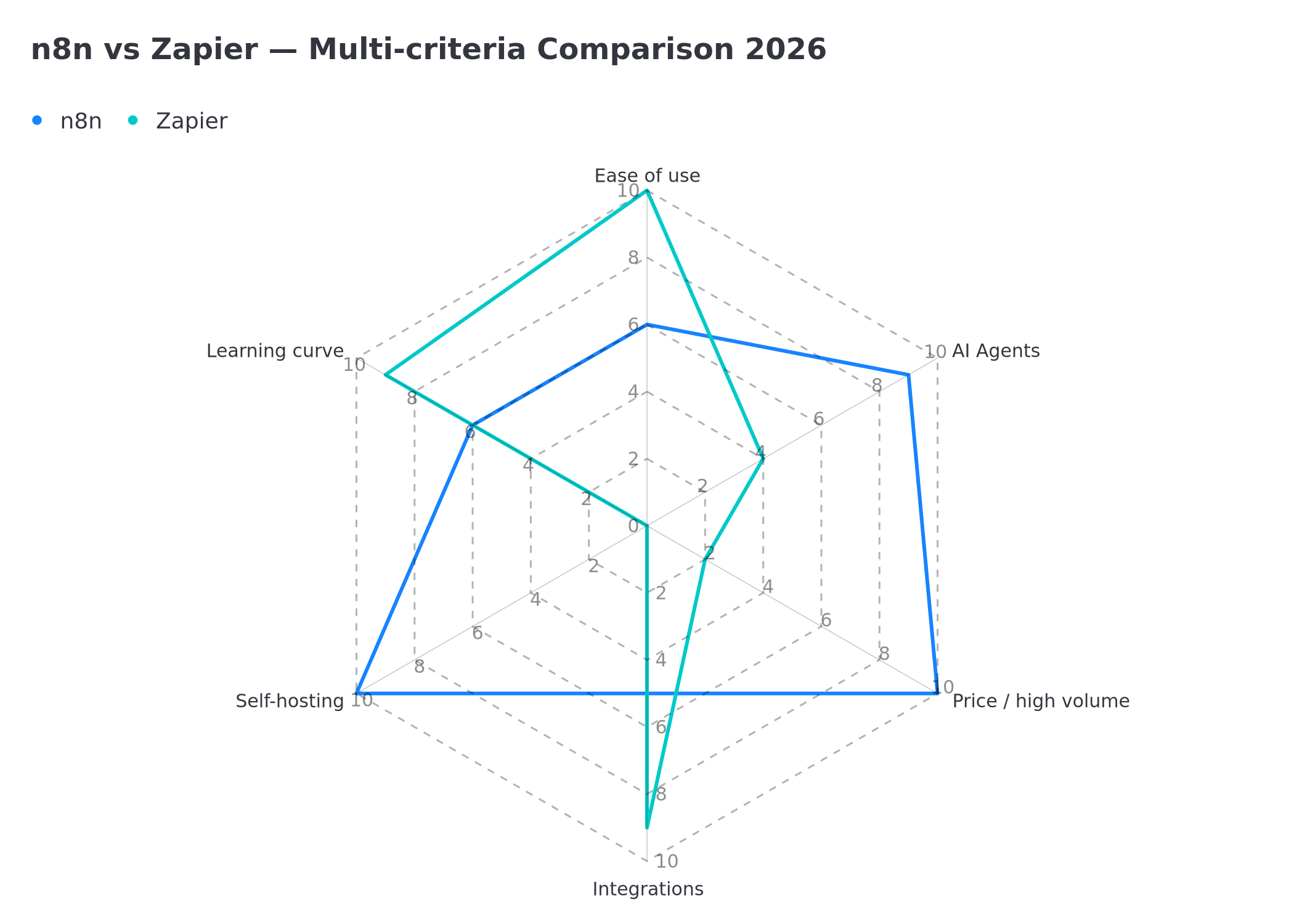 Radar comparison n8n vs Zapier: ease of use, AI agents, price at high volume, integrations, self-hosting, learning curve
The radar above sums up the dynamic: Zapier dominates on ease of use and integration catalog, n8n wins on price at high volume, self-hosting and AI agents. Neither is "better" in absolute terms — it all depends on which axis matters most to you.
How does billing work for n8n and Zapier?
This is the most misunderstood point, yet the most decisive for your invoice. The two tools do not count the same thing.
Zapier's "task" model
Zapier bills per task. A task is each action that runs inside a Zap. If your Zap fires a chain of four actions (enrich a lead, add it to the CRM, send an email, ping Slack), a single run consumes four tasks. Multiply by your monthly lead count and you understand why the bill climbs fast as your scenarios grow more complex. The trigger itself is generally not counted as a task.
n8n's "execution" model
n8n Cloud bills per execution. An execution is one whole workflow run, regardless of how many steps it contains. The same four-action scenario consumes a single execution. When self-hosted, n8n simply counts nothing: the only limit is your server's power.
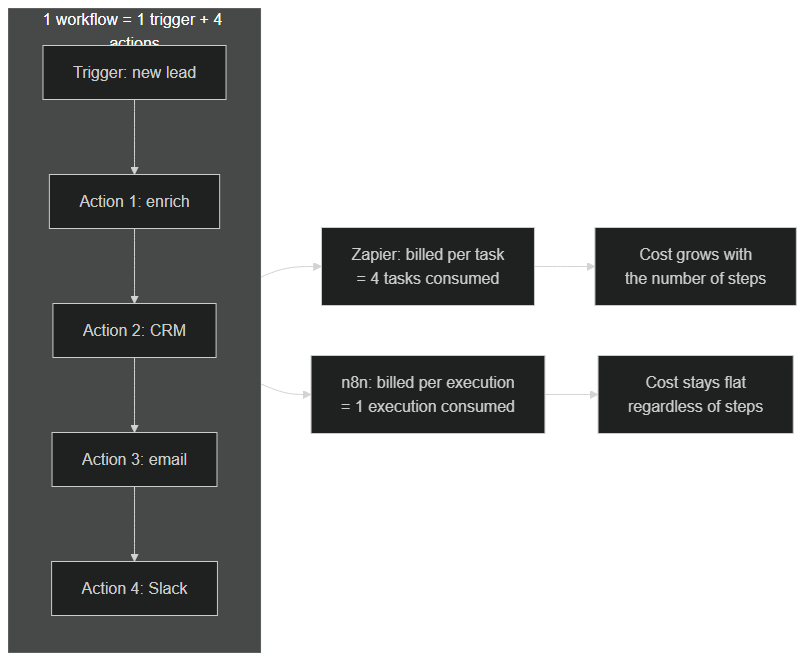 Diagram comparing billing: Zapier counts each action as a task, n8n counts a full workflow run as a single execution
This difference is structural. For simple workflows (1–2 steps), the gap is small. For rich workflows (5, 10, 20 steps), n8n is mechanically far more economical, because you only "pay" one counter per run. This is exactly the logic we break down in our analysis of n8n and Make automation pricing.
n8n vs Zapier: which one is cheaper in 2026?
Short answer: n8n, especially self-hosted and especially at high volume. Long answer: it depends on your total cost profile (tool + time + infrastructure).
n8n's pricing tiers (mid-2026)
- n8n Community (self-hosted): free and open source. You only pay for hosting — a small VPS is enough to start, for a few dollars per month.
- n8n Cloud: several monthly tiers billed per execution, from an entry plan for small volumes up to Pro/Business plans for teams. Exact amounts are on the official n8n pricing page.
Zapier's pricing tiers (mid-2026)
- Free: a very limited quota of tasks and Zaps, for testing.
- Starter / Professional / Team / Company: increasing tiers measured in tasks/month, with features unlocked along the way (multi-step, conditional paths, team access). The high end runs into hundreds of dollars per month.
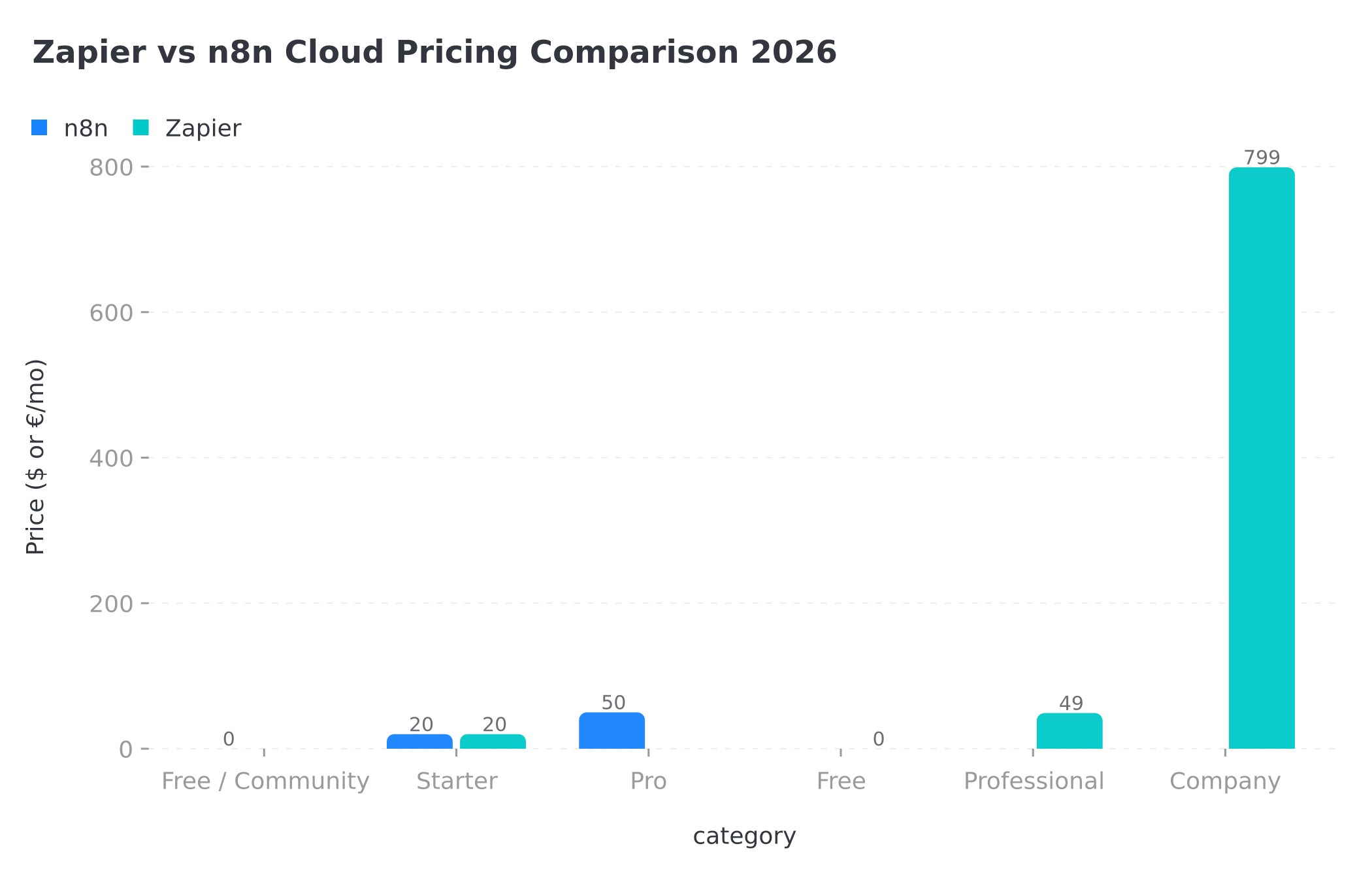 Price comparison by plan Zapier vs n8n Cloud: Free/Community, Starter, Pro/Professional, Company
The real cost at scale
The real question is not the price of the entry plan, but the cost at scale. Since Zapier bills per task and n8n per execution (or nothing when self-hosted), the gap widens as your volumes grow.
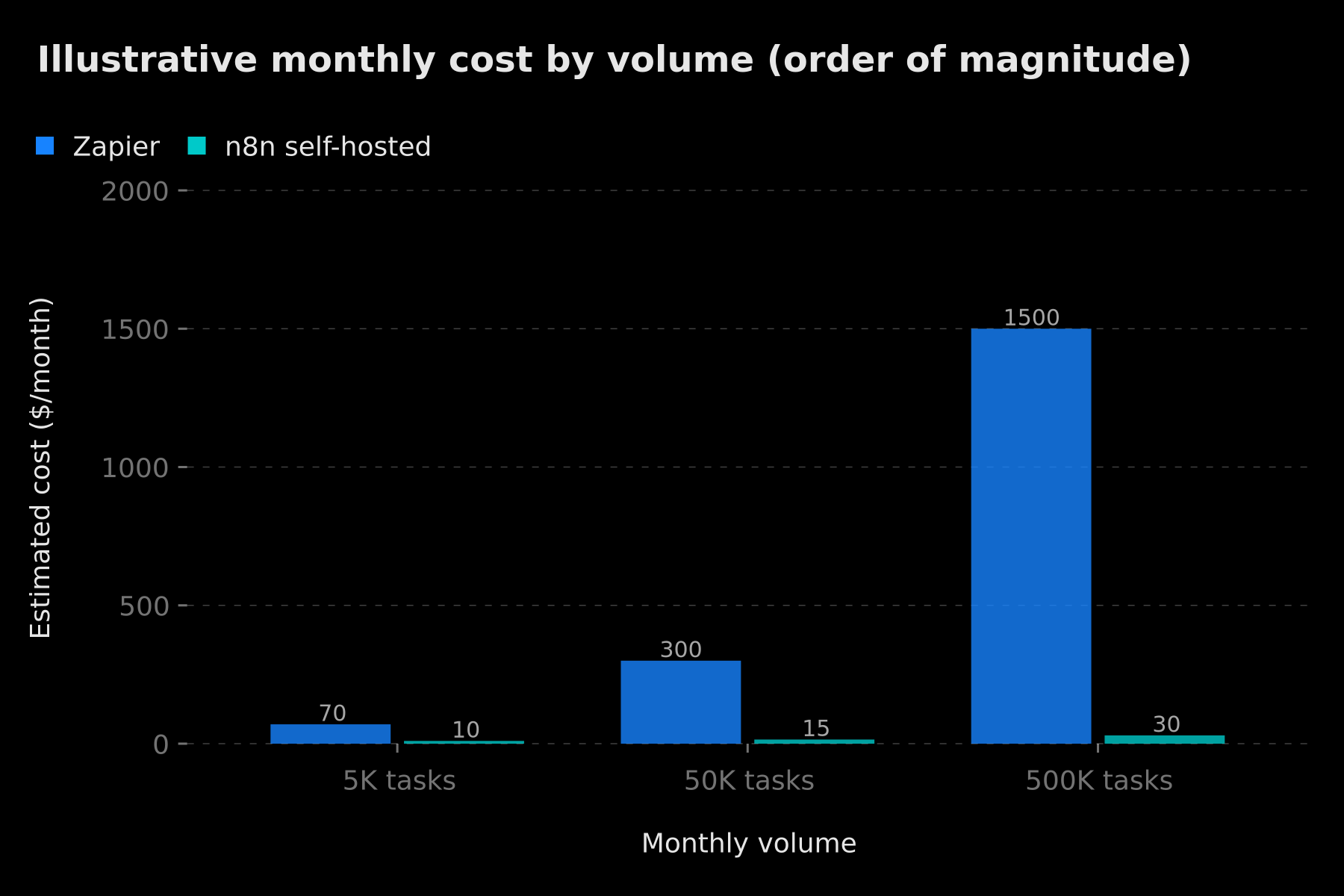 Illustrative monthly cost (orders of magnitude, non-contractual) showing the growing gap between Zapier and self-hosted n8n as volume increases
Important: the values in the chart above are illustrative (orders of magnitude, non-contractual). They exist to show the shape of the curve — Zapier grows with volume, self-hosted n8n stays nearly flat — not to give a quote. For a precise figure, start from your real volumes and the official pricing pages.
Pricing verdict: for small, occasional volumes, the gap is marginal and Zapier stays comfortable. As soon as you automate seriously (multi-step workflows, thousands of runs per month), n8n becomes clearly more economical, and self-hosting makes the marginal cost almost zero.
How many integrations do n8n and Zapier offer?
This has historically been Zapier's favorite battleground — and it remains unbeatable on raw count.
Zapier's library
Zapier offers several thousand native integrations, carefully maintained, with ready-to-use triggers and actions for nearly every mainstream SaaS. If you use a niche tool (an exotic CRM, a little-known marketing app), there is a strong chance Zapier has already packaged it, OAuth authentication included. That is a considerable time-saver.
n8n's approach: native nodes + universal HTTP + community
n8n offers several hundred native nodes — fewer than Zapier in count, but covering every major tool. Above all, n8n plays a different card: the HTTP Request node, which connects to any REST API. If a service exposes an API (and most do), n8n can hook into it, even without a dedicated node. Add the community nodes published by the open-source ecosystem, and real-world coverage becomes very broad.
The nuance: on Zapier, a native integration is "a few clicks". On n8n via HTTP, you sometimes need to read the API docs and configure authentication yourself. More flexibility, a bit more effort. The same catalogue-vs-HTTP trade-off on the Make side lives in the n8n vs Make comparison — not here.
n8n vs Zapier: which is better for AI and agents?
This is where the gap has widened the most since 2025. n8n took a clear lead on agentic automation.
n8n ships a genuine AI Agent node built on LangChain. You visually assemble an LLM, tools (your own workflows, API calls, databases), memory and reasoning logic, all in the same interface. Key capabilities:
- Multi-step reasoning: the agent decides for itself which tools to call and in what order.
- Persistent memory: it keeps context from one conversation to the next.
- Built-in RAG: native connection to vector stores (Pinecone, Qdrant, PGVector) to query your own documents.
- Human-in-the-loop: inserting a human validation in the middle of an agentic flow.
If this topic interests you, our dedicated guide on turning your n8n workflows into intelligent systems shows how these building blocks fit together in practice.
Zapier, for its part, has integrated AI gradually (text generation, assisted steps, a Zap copilot). Useful for simple cases: it stays closer to “AI that assists the Zap” than an agent that orchestrates tools. The agents angle (HITL, Ollama, Make AI Agents) is in Make AI Agents vs n8n, not in this Zapier comparison.
Do you need to be a developer to use n8n or Zapier?
No in both cases — but the initial effort differs.
Zapier is built for non-technical users from day one. The interface is linear (trigger → actions), the vocabulary is deliberately simple, and you build a working first Zap in minutes. It is the ideal tool for someone who has never touched automation.
n8n requires a small ramp-up. Its canvas interface (nodes linked by connections) is more powerful but less immediate. Plan on a few hours for a motivated non-developer before feeling comfortable. In exchange, this visual interface reveals the logic of your flows better and makes debugging complex scenarios easier. Understanding concepts like JSON, variables and API calls is not mandatory to start, but it unlocks advanced cases.
In short: Zapier wins on speed of onboarding, n8n wins on mastery once the step is climbed.
Can you self-host n8n? (self-hosting and sovereignty)
Yes, and it is one of n8n's strongest arguments — a field where Zapier simply does not play.
With n8n, you can install the engine on your own server (a VPS, an on-premise machine, a Kubernetes cluster). Your data, your connection credentials and your execution history stay with you. For organizations subject to GDPR, or that handle sensitive data (healthcare, finance, customer data), this is often a non-negotiable requirement. The most common deployment goes through Docker — we explain it step by step in our guide to installing n8n with Docker.
Zapier, being a pure SaaS, routes your data through its cloud infrastructure. That is perfectly acceptable for many use cases, but it rules out scenarios where data sovereignty is imperative. There is no "on-premise" version of Zapier.
The flip side of self-hosting: you become responsible for updates, backups, security and the availability of your instance. This operational burden is real. For anyone who does not want to carry it, n8n Cloud offers the best of both worlds: the n8n philosophy, without server management.
n8n vs Zapier: extensibility and custom code
When your needs go off the beaten path, extensibility makes all the difference.
n8n allows writing custom code (JavaScript, and Python via some configurations) directly in a Code node, in the middle of your workflow. You can transform data freely, call libraries, and even build your own reusable nodes. For a technical team, the ceiling is almost non-existent: anything doable in code is doable in n8n.
Zapier offers Code steps (JavaScript or Python) and webhooks, which already covers many cases. But the environment stays more constrained: you remain inside the SaaS boundaries, with no access to the underlying engine and no way to create shared native nodes. For light custom logic, it is enough; for heavy, recurring transformations, n8n is more at ease.
A concrete example makes the gap tangible: imagine you need to parse a messy CSV, deduplicate rows against an external database, apply business rules, then push the cleaned result to three different systems. On Zapier you would chain several Code steps and stitch them together, often hitting payload or timeout constraints. On n8n you would write a single Code node that handles the transformation end to end, branch the output with native logic, and reuse that node across other workflows. The more your automation looks like real software, the more n8n's open architecture pays off.
What are the limits of n8n and Zapier?
No tool is perfect. Here are the honest trade-offs of each.
Zapier's limits
- Cost at scale: per-task billing becomes penalizing on high-volume, multi-step workflows.
- No self-hosting: impossible for contexts requiring data sovereignty.
- Capped flexibility: you stay within the product's frame, with no access to the engine.
- Less advanced AI agents than n8n's for autonomous orchestration.
n8n's limits
- Learning curve a bit steeper at the start.
- Operational burden when self-hosted (maintenance, security, backups).
- Fewer native integrations than Zapier in raw count — offset by the HTTP node, but with configuration effort on rare services.
- Some complex OAuth authentications are faster to wire up on Zapier.
Summary table: n8n vs Zapier by criterion
| Decision axis | Advantage |
|---|---|
| Speed of onboarding | Zapier |
| Number of ready-to-use integrations | Zapier |
| Niche OAuth authentications | Zapier |
| Cost at high volume | n8n |
| Multi-step workflows | n8n |
| AI agents and agentic automation | n8n |
| Self-hosting and data sovereignty | n8n |
| Custom code and custom nodes | n8n |
| Zero infrastructure maintenance | Zapier (or n8n Cloud) |
Can you migrate from Zapier to n8n?
Yes, and it is a scenario we see very often: a team starts on Zapier, validates the value of automation, then watches the bill climb and decides to migrate to n8n to regain cost control. The good news is that the logic stays the same — a trigger, conditions, actions. The transition is therefore not about relearning everything, but about re-mapping your existing Zaps into n8n workflows.
A few field-tested tips:
- Do not migrate everything at once. Start with the most task-hungry workflows (the multi-step or high-volume ones): they pay back the migration immediately.
- Use it to rationalize. Many Zaps accumulated over time are redundant or could be merged. A migration is the ideal moment to audit and simplify.
- Anticipate niche integrations. Check upfront that the rare services you use have an n8n node or, failing that, a usable API via the HTTP Request node.
- Choose your hosting. If you are not ready to run a server, start on n8n Cloud, and switch to self-hosting later once the team is comfortable.
Concrete use cases: who gains what?
To anchor the comparison, here are typical situations:
- A freelancer who wants to automatically send an invoice after a Stripe payment and file it in their Drive: Zapier is more than enough, and the free quota or first tier covers the need.
- An e-commerce SMB syncing orders, stock, transactional emails and internal notifications across hundreds of orders a day: n8n quickly becomes more cost-effective, because each order triggers a multi-step workflow.
- An agency that wants to build an AI agent able to qualify leads, query a knowledge base and route requests: n8n is the only one of the two to offer that agentic orchestration natively.
- An HR team that must keep candidate data on its own servers for compliance reasons: self-hosted n8n is the only viable option.
This use-case reasoning is, in our view, far more reliable than an abstract ranking: start from your real scenario, estimate the number of steps and the volume, then let the billing model decide.
When to choose n8n?
Favor n8n if you recognize yourself in at least two of these situations:
- You expect high execution volumes or multi-step workflows.
- You want to build sophisticated AI agents with memory, tools and RAG.
- You handle sensitive data (GDPR, healthcare, finance) and require self-hosting.
- You want controlled long-term cost rather than a bill that tracks your volumes.
- You have (or can mobilize) a minimum of technical skills to exploit the tool's flexibility.
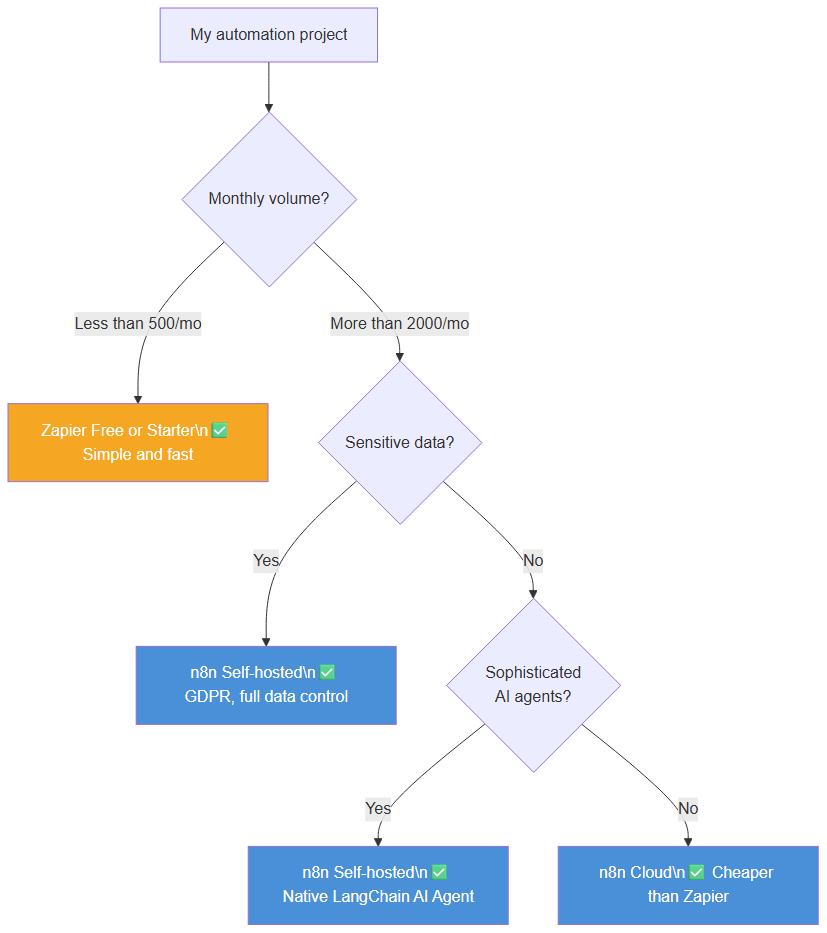 Decision tree to choose between n8n and Zapier based on volume, data sensitivity and AI agent needs
When to choose Zapier?
Stay on Zapier if your context looks like this:
- You are starting out in automation and want a first working flow in thirty minutes.
- Your volumes are low and your workflows simple (one to two steps).
- You need a rare native integration that Zapier already offers turnkey.
- You want to manage no infrastructure and data sovereignty is not a concern.
- Speed of implementation matters more than long-term cost control.
Our recommendation by profile
Rather than a universal winner, here is the reading we give our clients depending on their situation.
Beginner or solopreneur
Start with Zapier, or with n8n Cloud if you are curious about flexibility. The goal at this stage is to automate a first concrete task without drowning. If your volumes stay low, Zapier does the job perfectly.
SMB
This is often the tipping point. As soon as several multi-step workflows run daily, n8n becomes the better investment: controlled cost, flexibility, and the option to self-host customer data. Many SMBs start on Zapier then migrate to n8n once the bill becomes a topic.
Developer or agency
n8n. Custom code, nodes, self-host, agents. Among the 25 files, 6 name n8n and 0 name Zapier: that is not market-share ranking, it is the written stack. Scoping goes through the n8n agency.
Scale-up or high volume
Self-hosted n8n. At scale, per-execution billing (or its absence when self-hosted) and infrastructure control make n8n unbeatable on total cost of ownership.
Conclusion: n8n vs Zapier, the 2026 verdict
Zapier is for getting started fast. n8n is for going far — and for not watching your bill explode along the way.
The n8n vs Zapier debate is not settled in the abstract: it is settled by your trajectory. Zapier remains the gentlest entry point into automation, with an unmatched integration catalog and disarming simplicity. But as soon as we talk about volume, AI agents, data sovereignty or controlled long-term cost, n8n stands out as the more rational investment in 2026.
For a startup or SMB automating seriously, our recommendation is clear: build on n8n. Our team deploys custom n8n automations — free audit, architecture, full integration and support. Let's talk about your project.
Tags
FAQ
Is n8n really free?
Yes, n8n Community Edition is free and open source when self-hosted. You only pay for hosting (a small VPS, a few dollars per month). The managed n8n Cloud offering is paid, with monthly tiers — check the official pricing page for the exact amounts as of mid-2026.
Can n8n completely replace Zapier?
In the vast majority of cases, yes. The n8n HTTP Request node connects to any REST API, which covers most integrations missing from its native library. The main caveat: some complex OAuth authentications are still faster to set up on Zapier, which has already packaged them.
Do you need to be a developer to use n8n?
No. The visual interface lets you build workflows without writing code. Basic notions (JSON, APIs, variables) help for advanced cases, but most common automations require no programming. Zapier still wins for an absolute beginner who wants the fastest possible start.
What is the real difference between n8n and Zapier?
Philosophy. Zapier is a turnkey proprietary SaaS optimized for simplicity and integration count. n8n is an open-source tool you can self-host, billed per execution rather than per task, and designed for flexibility, AI and cost control at scale.
How does billing work for n8n and Zapier?
Zapier bills per task: each action that runs inside a Zap consumes one task. n8n Cloud bills per execution: an entire workflow run counts as a single execution, no matter how many steps it has. When self-hosted, n8n counts nothing — only your server has a cost.
How many BOVO files name Zapier?
None as of 13 September 2026. The register counts 14 Make.com files and 6 n8n files among 25 automation cases. We do not invent a Zapier volume. The n8n vs Make comparison is a different article.
We scope one workflow — not a generic demo
You describe a repeated task. We tell you what n8n would ship, the timeline, and what stays out of scope.
- 30 min
- 1 scoped workflow
- No commitment
William Aklamavo
Web development and automation expert, passionate about technological innovation and digital entrepreneurship.


